

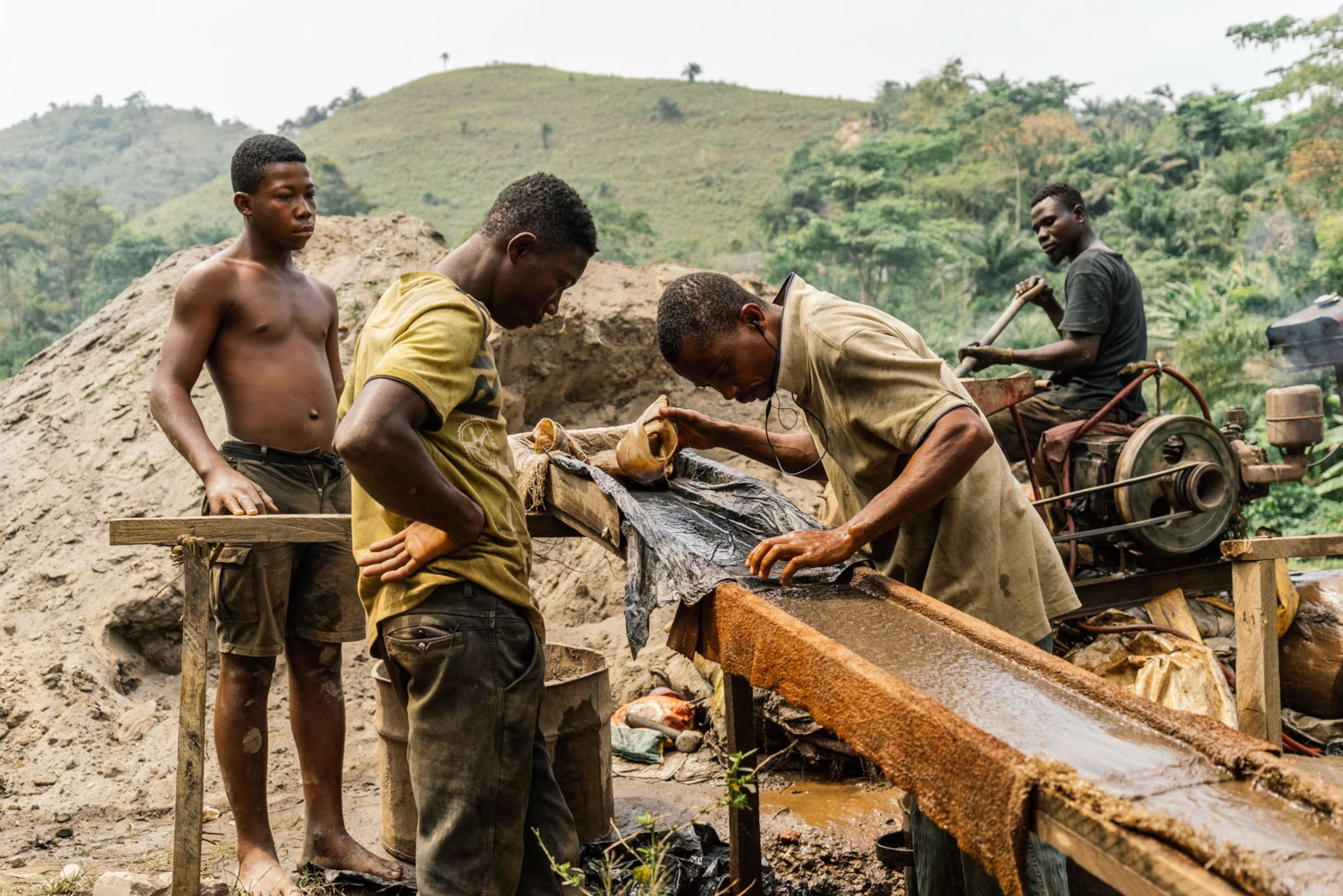
Ghana is facing a deepening national crisis caused by illegal small‑scale gold mining, widely known as galamsey, a word derived from “gather them and sell”. The practice is rapidly destroying rivers, forests, and farming communities. While often framed as an environmental or enforcement problem, the crisis represents a profound challenge to children’s rights and long‑term development.
Existing legal protections explicitly prohibit exploitative child labour and activities that undermine children’s health, education, or development. However, galamsey has strained this framework to breaking point, as their right to education, right to life, right to health and right to protection from economic exploitation and hazardous work are severely challenged by the practice. What was once a localised regulatory issue has evolved into a nationwide emergency that structurally reproduces child labour and educational exclusion at scale, with disproportionate impacts on women and girls.
A water emergency
Illegal gold mining produces mercury and cyanide that then runs off into Ghana’s water system, with devastating consequences for both human health and the environment.
The Ghana Water Company Limited has recorded water quality levels far exceeding treatable limits. As a result, there are warnings that the country could be forced to import water by 2030 if illegal mining continues unchecked. It is estimated that 60 per cent of Ghana’s water bodies are polluted, including major rivers such as the Pra, Ankobra, and Birim. In some regions, clean water supply has reportedly declined by as much as 75 per cent, highlighting the escalating risk to public health and livelihoods.
Pregnant women and children are particularly exposed to harm. Medical evidence links mercury exposure to neurological damage, developmental disorders, long‑term cognitive impairment, and congenital malformations. The Paediatric Society of Ghana has reported that heavy metal exposure associated with illegal mining contributes directly to child mortality and lifelong health deficits among survivors. These outcomes represent the cumulative effects of prolonged governance failures that have allowed toxic mining practices to persist unchecked over decades.
The education emergency
This water emergency is inseparable from children’s well‑being. A lack of access to clean water during the dry season is associated with reduced school attendance and increased child labour for profit. When rivers become toxic, households must travel further to secure water, increasing domestic burdens that fall disproportionately on women and girls. Water insecurity is intensifying, so children are more likely to miss school, enter hazardous work, or experience long‑term developmental harm. Galamsey is not only degrading ecosystems but also undermining children’s rights and threatening the country’s future development, demanding responses that go beyond sporadic crackdowns to address structural causes and protection failures.
Research indicates that child involvement in mining significantly disrupts school attendance, with many children prioritising mining over education and remaining out of school once exposed to mining income. The social consequences extend beyond education. Communities near galamsey sites experience rising school dropout rates, truancy, teenage pregnancy, drug abuse, prostitution, and human trafficking, as the thriving environment of illegal activities with no prospect of surveillance serves as fertile grounds for exploiting the vulnerable. Girls are often drawn into informal and exploitative economies around mining camps, while boys abandon schooling for hazardous labour. As these patterns persist, galamsey is actively reproducing intergenerational poverty, undermining children’s rights, eroding community cohesion, and threatening Ghana’s long‑term human development and social stability.
The development paradox
Ghana’s galamsey offers short‑term economic benefits while producing long‑term environmental, social, and developmental costs. Artisanal and small‑scale mining, when formalised and regulated, can contribute significantly to livelihoods and national income. However, galamsey operates outside these regulatory frameworks, undermining both environmental sustainability and the state’s fiscal capacity.
While it may offer immediate income to marginalised households, it systematically erodes the ecological, agricultural, and human capital foundations required for sustainable development. Polluted rivers, degraded forests, and unusable farmland weaken communities’ capacity to farm, fish, or attract future investment, depleting long‑term productive capacity.
Despite a robust legal framework, including the Children’s Act 1998 and the Minerals and Mining Act 2006, enforcement has been minimal. Previous analyses have highlighted a persistent gap between formal legal protections and lived realities in mining communities, a gap that has widened over time. Hundreds of excavators seized from illegal miners have reportedly disappeared, and although prominent politicians and financiers have been implicated, prosecutions have not yielded the desired results. No employer has received a custodial sentence, illustrating the depth of institutional failure.
What development requires
At its core, the galamsey crisis is a children’s rights and development crisis shaped by poverty, weak governance, and unaccountable resource extraction. Gendered impacts are central, not peripheral, with women and children bearing the greatest health and social costs while having the least influence over governance decisions.
Ultimately, galamsey persists because structural drivers, poverty, unemployment, corruption, and weak enforcement remain unaddressed. Sustainable development requires confronting these root causes rather than relying on militarised crackdowns, raising fundamental questions about power, accountability, and whose interests are served by the continuation of illegal mining.