

Critical materials are substances that the U.S. government identifies as essential to energy technologies, economic and national security, and the manufacture of key products. This importance means the United States needs to ensure access to supplies of these materials. Supply chains that provide critical materials can be disrupted by events like sudden increases in demand, natural disasters that affect supply, and foreign governments restricting exports. The Department of Energy (DOE) has identified 18 critical energy materials that are important for the future of the energy sector.
Many critical materials have unique properties that make them important for advanced technologies. For example, some are used to create very strong, compact magnets, others speed up chemical reactions, and a few efficiently convert electricity into light. All of the critical materials identified by DOE are natural elements—none of them were created in laboratories. Almost all of these elements come from stars and supernovas, and only tiny amounts are created through radioactive decay and other means. That means the supply on Earth is all we have for now.
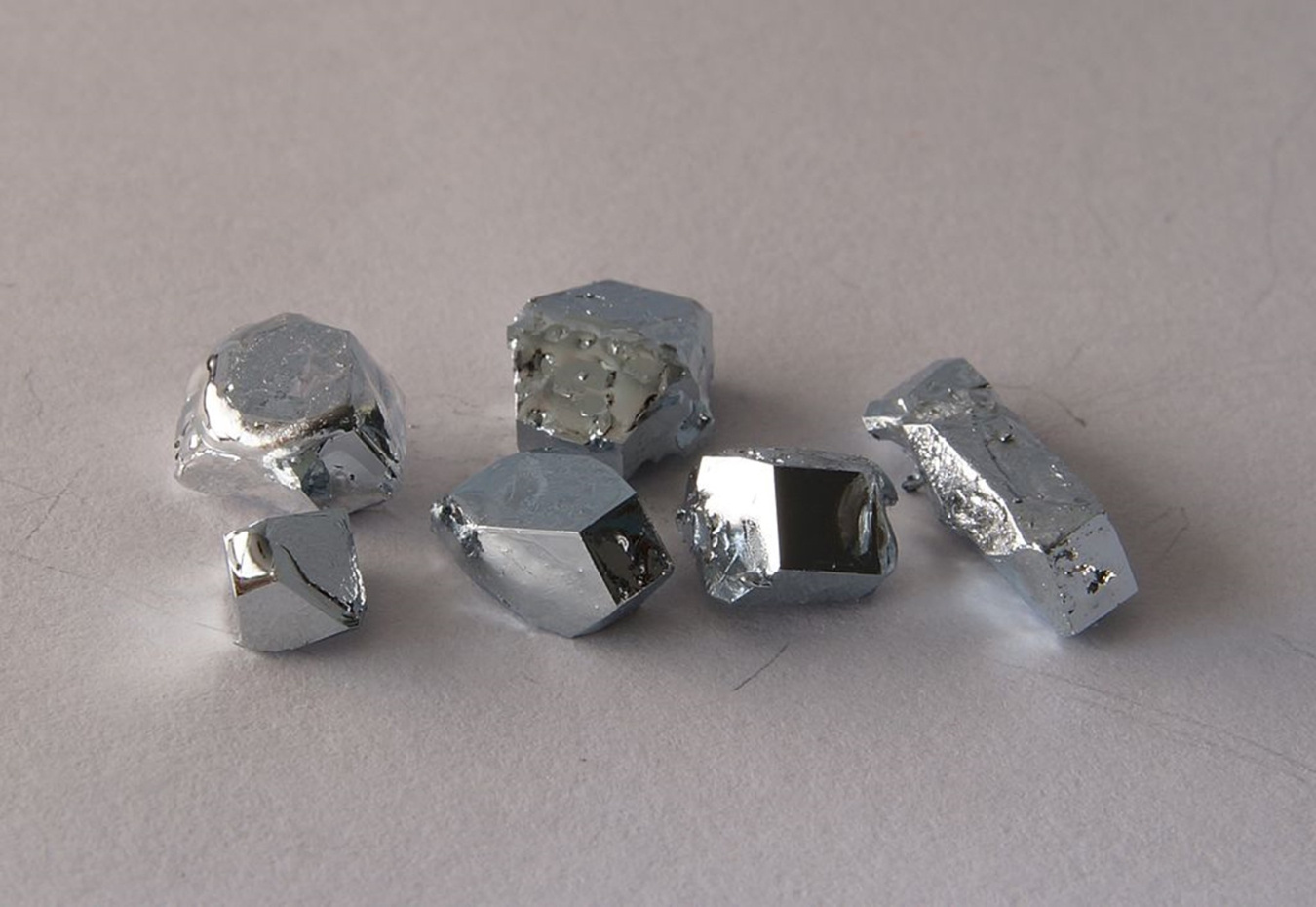
Gallium, pictured above, is one of these critical materials. Gallium is used to manufacture a range of electronic devices. It is commonly used in LED light bulbs, the communications chips in smartphones, and high efficiency power supplies. Because it is rare, gallium is not mined directly but is produced as a byproduct of aluminum manufacturing. China accounts for over 90% of the world’s gallium production and in 2023 announced severe restrictions on the export of this critical element.
DOE Contributions to Critical Materials Research
Critical materials are essential to clean energy technology, ranging from solar panels and wind turbines to electric vehicle chargers and batteries. Those uses are why DOE is closely involved with critical materials. Under the Bipartisan Infrastructure Law and Inflation Reduction Act, DOE oversees several key programs to address critical material concerns. DOE’s Office of Manufacturing and Energy Supply Chains (MESC) is leading work under three funding areas, the Battery Manufacturing and Recycling Grants, the Battery Material Processing Grants, and the 48C Tax Credit Program. MESC and DOE’s Office of Fossil Energy and Carbon Management (FECM) are leading work on the Rare Earth Elements Demonstration Facility. FECM is also enabling the production and processing of rare earth elements and other critical materials from mining and industrial wastes and other unconventional sources. DOE also created the Critical Materials Innovation Hub (CMI Hub). The Hub is led by Ames National Laboratory and managed by the DOE Advanced Materials and Manufacturing Technologies Office. The CMI is conducting applied research to advance technologies that can unlock new sources of critical materials, substitutes for these materials, and ways to make better use of existing material through reuse and recycling. CMI also studies new ways to enable science, sustain the environment, and analyze supply chain and economics of critical materials.
Fast Facts
- Learn more about critical materials—and all the elements—with the Royal Society of Chemistry’s online periodic table of elements.
- The critical materials include all but one of the 17 rare earth metals. These silvery metals are chemically similar. They are called “rare” in part because they tend to occur together and are hard to separate from other materials.
- Research projects supported by the DOE Office of Science could trim the cost of recycling critical materials.
- The European Union is also concerned about critical materials. Learn more about 12 of those materials in this guide from Politico.
Resources
- The DOE Critical Minerals & Materials Program, including the program’s definition of these materials
- The DOE Office of Science Basic Energy Sciences program, the locus of much of DOE’s work on critical materials.
- Setting a Scientific Foundation for Critical Materials
- The Critical Materials Innovation Hub
- DOE critical materials strategy report
- DOE Report on Recovery of REE/CM from Coal and Coal By-Products