

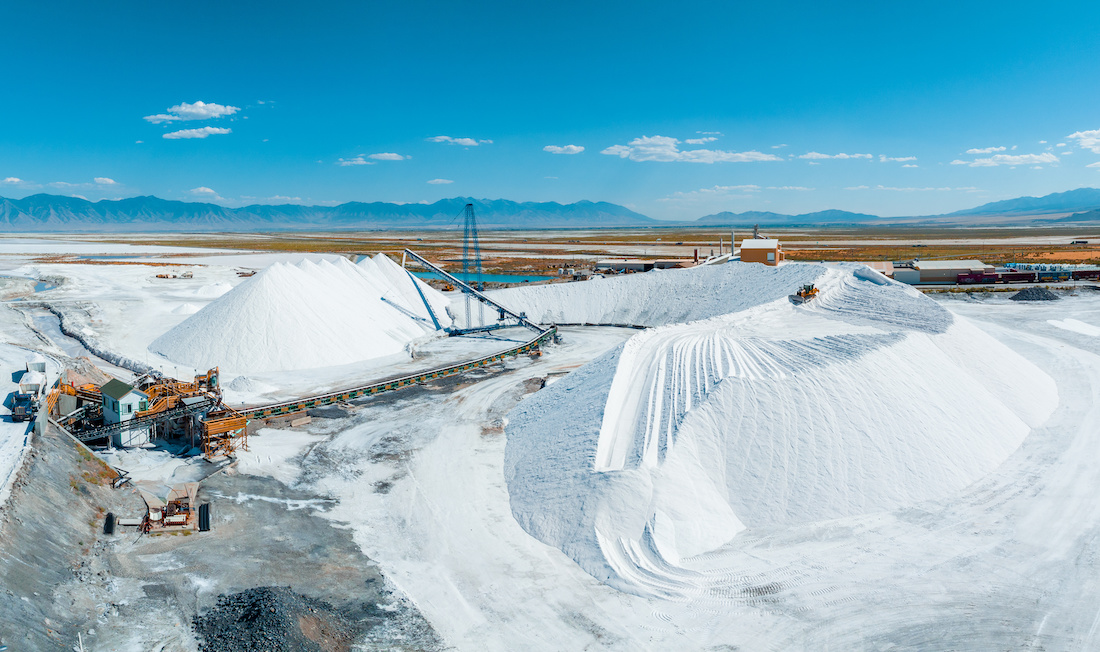
Growing water scarcity could hamper the expansion of lithium mining in the U.S., deepening its reliance on foreign imports over the coming decades, a new study finds.
Lithium is used in electric-vehicle and energy-storage batteries due to its high energy density and low weight compared with other minerals, but mining it requires a huge amount of water. Currently, the U.S. has only one active lithium mine, in Nevada, and with demand for the metal projected to explode over the next few years, the government and private companies are planning to open at least 115 new mines across the country, according to the study.
However, most of the proposed mines that are in advanced stages of development overlap with water-stressed areas, specifically in the western U.S. In the new study, published May 28 in the journal Communications Earth & Environment, scientists found that if lithium mines start operating in these regions, they will compete for water not only with households, agriculture and industry, but also with one another and with other proposed mineral mines.
“Future water availability under climate change may constrain whether new lithium mines will have sufficient water to operate,” study senior author Jennifer Dunn, a professor of chemical and biological engineering and the director of the Center for Engineering Sustainability and Resilience at Northwestern University in Illinois, told Live Science in an email.
The U.S. imports more than 50% of its lithium, mostly from Chile and Argentina. Policymakers and corporations want to reduce this dependence, but even with the existing Nevada mine and the 22 proposed mines that are the closest to coming online, the U.S. won’t have enough lithium to meet domestic demand, Dunn said.
“Every mine produces a different amount of lithium — depending on its deposit type, lithium grade, and final product — so we are unable to determine how many mines exactly would be needed,” she said. “Our analysis estimated that if all 22 advanced [stage] proposed mines and the sole operating mine continued operation into 2050, 0.14 [to] 0.25 million metric tons [0.15 to 0.28 million tons] of lithium content in products could be produced per year.”
This range falls short of the 0.83 million to 1.9 million tons (0.75 million to 1.7 million metric tons) of lithium per year that other researchers previously estimated the U.S. would need to cover its own demand.
However, the water demand to produce more lithium would be astronomical. That’s because lithium is typically extracted from brines and rocks known as pegmatites, which require large-scale evaporation and aggressive processing with fresh water, respectively.
To find out if the U.S. would have enough water to support additional lithium mines under intensifying climate change, the researchers calculated the future water use of the 23 lithium mines most likely to be active in 2050, using data from mining companies. Then, they layered this projected water use on top of projected water uses from other sectors, such as agriculture and manufacturing, under four modeled socioeconomic-climate scenarios between 2040 and 2060.
The researchers found that the available water supply will, in most cases, be insufficient to support new lithium mines. The starkest example was Southern California’s Salton Sea, which contains roughly 4.5 million tons (4.1 million metric tons) of lithium. The Salton Sea is fed by the Colorado River and showed the least water available to support lithium mining and other water demands, owing to the river’s dwindling flow.
By – https://www.yahoo.com/news/science/articles/water-shortages-could-prevent-us-094925391.html?guccounter=1&guce_referrer=aHR0cHM6Ly93d3cuZ29vZ2xlLmNvbS8&guce_referrer_sig=AQAAAM7nTIK1ibaEprG1ocD5f6rfTqOMAlYmHnd960hKEXiujCxF56mcevbf72Ke2XbI4IeK3-ShdQqGjg_AttoOEh5PF4AjdTnrMRaalXbJg03N2Vi6t7ZjfTSsO7tBAdYSCJ9CgNlEjJV-A8ObXipfBRayjvYx11EzPeZOEk-u6Ofk