

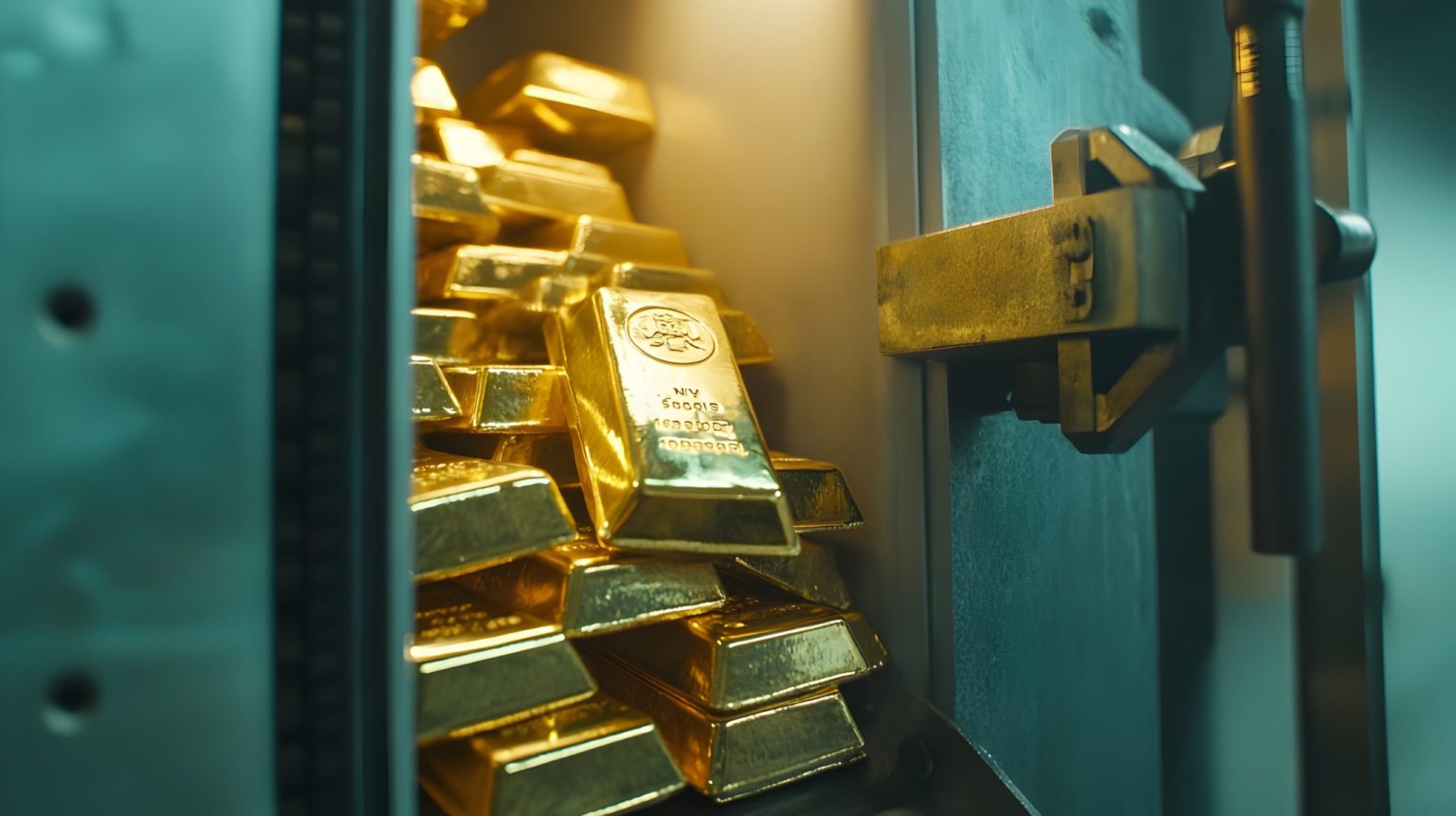
Gold’s slide back below $4,000 an ounce wipes out most of mining’s 2026 gains, but the old guard of diversified giants – led by a resurgent BHP – is staging a comeback.
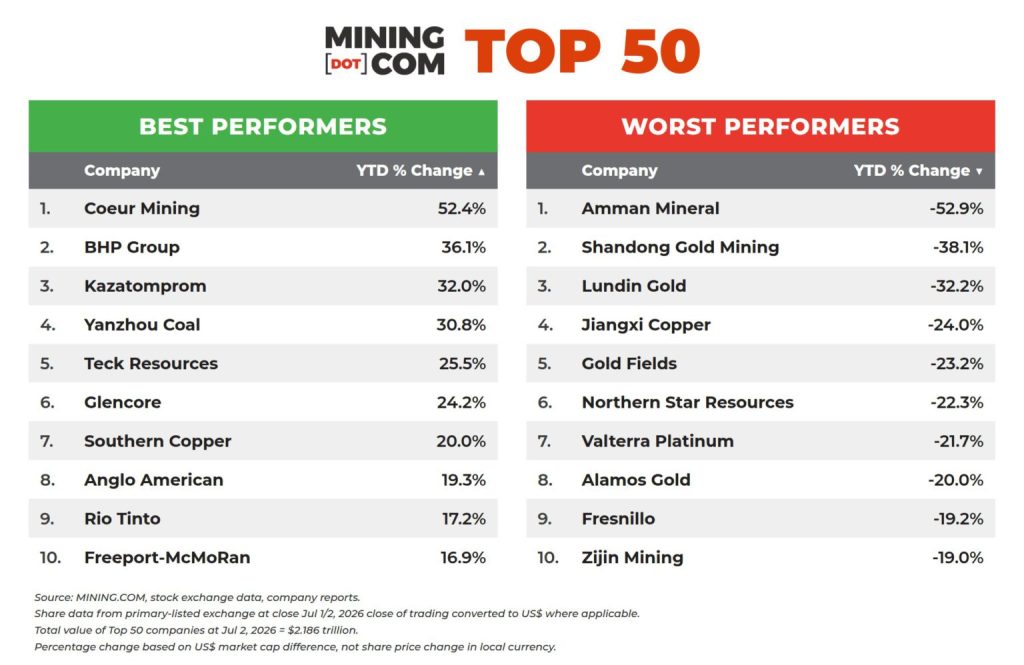
At the end of the second quarter the MINING.COM TOP 50* ranking of the world’s most valuable miners had a combined market capitalization of $2.19 trillion, down $228 billion over the three months and hanging on to a gain of just $22 billion so far in 2026.
After a first quarter in which the ranking powered through the outbreak of the US-Iran war to touch $2.41 trillion, the June quarter handed nearly all of those gains back.
Gravity catches gold
Gold entered the quarter within sight of its late-January record of $5,589 an ounce and exited it fighting to hold $4,000, falling through the psychological level in the final week of June. The rally that looked gravity-defying in January has given way to a full-blown retreat and even the biggest bulls on Wall Street spent June trimming their targets.
For the precious metals contingent – still 17 companies strong and more than a quarter of the index’s overall value – the damage was uniform and ugly. Agnico Eagle (TSX:AEM), which entered the rarified atmosphere of the triple-digit billions in January, gave back $28 billion or 26% of its value over the three months.
Kinross shed a similar proportion, Gold Fields lost 28%, and Shandong Gold was cut down by 40% – a 16-place fall to number 46 that counts among the steepest quarterly drops in the history of the ranking. Not even the royalty and streaming trio of Wheaton, Franco-Nevada and Royal Gold (often a place to hide when bullion wobbles) offered shelter, declining 18%–23%.
The exception was Newmont. The world’s number one gold miner fell a comparatively modest 16% and vaulted over Zijin Mining into fourth place overall. The explanation is rather pedestrian: Denver never ran as hot as its rivals on bullion’s way up, so it had less froth to give back – down 7.5% for the year versus double-digit losses across the gold patch. In other news, Newmont’s Red Chris mine in British Columbia received the regulatory okay for its expansion in June.
Copper’s winners and losers
Copper had a wilder ride than quarter-end prices suggest, setting a record $6.72 a pound ($14,800 a tonne) on COMEX in mid-May before fading. The bellwether metal started Q3 on the front foot although not everyone agrees that the rally will have legs.
The MINING.COM TOP 50’s celebration in January of a six-member $100 billion club lasted exactly one quarter: Agnico’s exit leaves five, with Xiamen-based Zijin clinging on by less than $1 billion after a 20% drop. Freeport-McMoRan, idling at $86 billion, waits by the rope and Glencore, the most copper-geared of the diversified majors, briefly flirted with the $100 billion mark of its own, touching some $95 billion in early June before a roughly 20% slide left it seventh at just under $80 billion by quarter-end. Q3 brought more bad news: just this week tax authorities in the DRC sealed off the Swiss company’s offices in Kolwezi alleging billions of arrears.
For years these pages have documented how the old guard failed to keep up with the new world of mining. Not this quarter. BHP (ASX:BHP) added 16% – $28 billion, more than Fresnillo at #27 is worth in its entirety – to reach $209 billion, comfortably back above the double-century mark Melbourne-based BHP became the first miner ever to breach earlier this year. Rio Tinto, kicked off its number two perch in January, has safely reclaimed it at $162 billion.
Anglo American climbed four spots to number 13, adding 12% as its great slim-down and merger with Teck Resources nears completion. The proposed merger has received shareholder approval and moved into the settlement process, with Teck mailing share-exchange documents in late June, although Beijing’s regulator has not pronounced on the deal. Teck said it should all be wrapped up at the latest in March next year. A Teck-Anglo American combination would nominally be worth about $82 billion which would rank the merged group seventh.
Southern Copper held third position and Teck jumped 13%. First Quantum’s 10% advance was worth a 10-place climb to number 31 – the biggest move up the ranking this quarter – as a government audit of the shuttered Cobre Panama mine boosted hopes of a restart. The environmental review found the giant copper operation 88% compliant with its obligations, removing a key obstacle to bringing it back online.
Revolving door
KGHM returns at number 42 after dropping out at the end of 2024 as its peers received reratings and the bar for inclusion was raised. The Polish copper miner’s eighteen months in the wilderness were ended by a 21% surge in the June quarter and an $8.55 billion investment plan at home.
Hindustan Zinc debuts at number 30 courtesy of corporate surgery. Parent Vedanta completed its long-promised break-up during the quarter, and with the aluminium, power, oil and steel businesses now trading separately, the residual Vedanta makes way for its 63%-owned mining subsidiary under the ranking’s one-entity rule. (The newly listed Vedanta Aluminium, India’s largest producer of the metal, buys rather than mines its bauxite.)
The price of admission, meanwhile, has fallen back to $13 billion from $18 billion three months ago – a mercy for Amman Minerals. The first Indonesian company to crack the top 50 after its blockbuster 2023 debut, Amman’s ascent minted at least half a dozen new billionaires and briefly pierced the top 10, but the stock has now surrendered roughly three quarters of its peak value, including 35% in Q2 alone, to sit dead last at number 50.
Despite the frenzied rally that has gripped the sector — and the billions in government and strategic money pouring into Western magnet supply chains, from the Pentagon taking a cornerstone equity stake in MP Materials to Apple’s $500 million magnet deal — the rare earth heavyweights can’t hold a place at the top table. MP Materials, which cracked the ranking for the first time in 2025 at number 40 after its shares tripled on the back of the Pentagon pact, has since surrendered roughly half its value to about $9 billion. After that brief cameo the Las Vegas-based company now languishes well outside the cut-off, and Australia’s Lynas, at around $12 billion, hovers just shy of the top 50 too. That leaves state-backed China Northern Rare Earth, 28th at $26 billion, as the sector’s lone standard-bearer among the world’s 50 most valuable miners — a telling reminder of where the supply chain’s centre of gravity still lies.
Uranium’s staying power, lithium’s disconnect
The world’s largest uranium producers, Cameco and Kazatomprom, spent years outside the ranking after Fukushima. Now their standing looks the most secure it has ever been. Cameco sits at number 17, while Kazatomprom – up 32% in 2026 and the third-best performer of the year – holds number 37. The equities are tracking the long-term contract cycle, not the spot market, where yellowcake has slid from its January highs to idle in the mid-$80s. Teniz Capital is calling a multi-year structural bull market, and for once the shares are not arguing.
Lithium supplied this year’s great disconnect. Battery-grade carbonate nearly doubled between December and late January – a squeeze turbocharged by Ganfeng’s chairman predicting a 2026 demand boom – and, despite analysts calling the rally short-lived, was still trading near $22,400 a tonne at the end of June, up roughly a third for the year.
The equities refused to follow: SQM, Ganfeng and Albemarle all remain in the ranking, and all three lost between 13% and 25% of their value in the quarter. The value destruction since the sector peaked in 2022 – six counters worth a combined $120 billion at the top – has been documented in these pages as nothing short of astonishing. Today’s three survivors muster $55 billion between them. The punters, evidently, remember the last boom too well.