

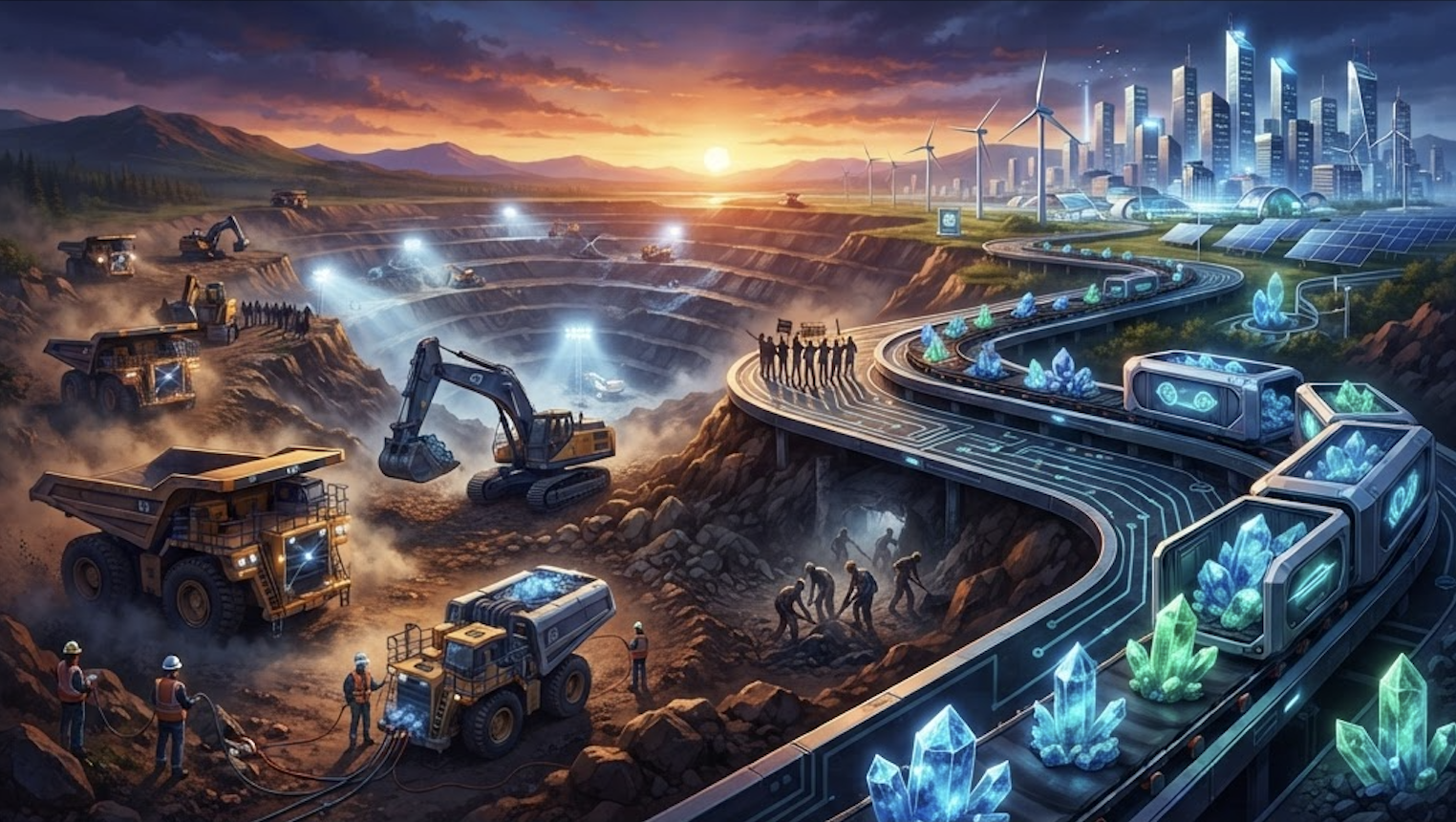
Global mining was once the quiet bedrock of industrial economies. Today, it is in the throes of a seismic shift. Driven by an insatiable appetite for minerals—cobalt for batteries, copper for electrification—the industry finds itself at a perilous crossroads. A confluence of surging demand, aggressive corporate consolidation, and a disturbing rise in human rights abuses paints a contradictory picture of our transition to a sustainable future.
Projected to reach $3.5 trillion by 2032, the mining sector faces a harsh financial reality. Revenues for the top 40 mining companies fell by 7% in 2023, with another 6% drop anticipated in 2024. This financial squeeze is paradoxically accelerating a frantic race for ‘critical minerals’ essential for renewable energy and digital infrastructure. It is not a unified march toward sustainability, but a fragmented scramble defined by mega-mergers and the weaponization of global supply chains.
The Unsettling Reality: Mining’s Financial Squeeze and the Critical Minerals Race
Copper and lithium now dominate 70% of critical mineral deal volumes, fueled by the electric vehicle boom and the data demands of artificial intelligence [Source: Infosys Mining Industry Outlook 2024]. Yet, demand hasn’t brought prosperity. For the first time since 2016, top-tier companies saw revenues decline. This pressure forces a push for scale. Consider the potential $260 billion merger between Rio Tinto and Glencore; it is a clear attempt to create a mining superpower and secure a dominant position in the energy transition.
Navigating the ‘Copper Craze’ and the EU’s Strategic Pivot
Analysts call the current global scramble the ‘copper craze.’ Major players are pivoting to secure these assets; for instance, Rio Tinto recently invested $6.7 billion into lithium [Source: Infosys Mining Industry Outlook 2024]. To curb its reliance on external suppliers like China, the European Union enacted the Critical Raw Materials Act (CRMA). Effective May 2024, the CRMA mandates that by 2030, 10% of strategic raw materials must be mined domestically, 40% processed within the Union, and 25% recycled.
The Double-Edged Sword: Technology’s Promise and Unfulfilled Environmental Pledges
Technology offers a vision of a cleaner future. The ‘Connected Mining’ market, valued at $17.26 billion in 2024, now utilizes AI for operational gains and 5G-enabled autonomous fleets to solve labor. Innovations like sensor-based ore sorting could cut energy and water consumption by half. Furthermore, dry-stack tailings aim to prevent the catastrophic failures common with traditional dams. However, these leaps often mask a darker reality. Reports show severe water contamination and land displacement in poorly regulated areas. The dream of green mining is often overshadowed by ‘sacrifice zones’—communities devastated by the massive water requirements of lithium extraction.
Human Rights Under Pressure: Exploitation in the Shadow of the Green Transition
The demand for ‘transition minerals’ has accelerated exploitation. In 2024 alone, 156 new abuse allegations were recorded, bringing the total to 630 since 2010. Copper accounts for 44% of these. In the Democratic Republic of Congo, cobalt mining has been linked to skin diseases and gynecological issues among local women. Meanwhile, in Indonesia and the Philippines, nickel mining has sparked land grabbing and forced evictions. The green transition is being bankrolled by the suffering of vulnerable populations.
Deep-Sea Dreams and Terrestrial Realities: Innovations in Extraction
Companies are now looking to the ocean floor. Firms like Impossible Metals are developing AI-driven robotic harvesters to gather deep-sea polymetallic nodules with minimal ecological damage. The International Seabed Authority expects to adopt a ‘Mining Code’ by 2025. On land, automation is taking over. From Sandvik’s AutoMine to battery-electric underground trucks, the industry is racing to modernize.
Accountability Gap: Where Corporate Responsibility Meets Financial Flows
Financial pipelines remain dangerously murky. Oxfam reports that between 2016 and 2024, European banks funneled €64 billion into mining companies with weak environmental safeguards. Major banks like Crédit Agricole and Allianz currently hold low accountability scores. Similarly, while some EV manufacturers are improving, many—including BYD and Hyundai—lack transparency in their deep-tier supply chains. Capital continues to flow into abusive practices without adequate remediation.
The Future of Mining: Balancing Demand, Sustainability, and Ethical Concerns
The industry is at a breaking point. We desperately need minerals for decarbonization, but the human and environmental costs are unsustainable. Digitalization offers a potential path forward, but only if matched with robust accountability.