

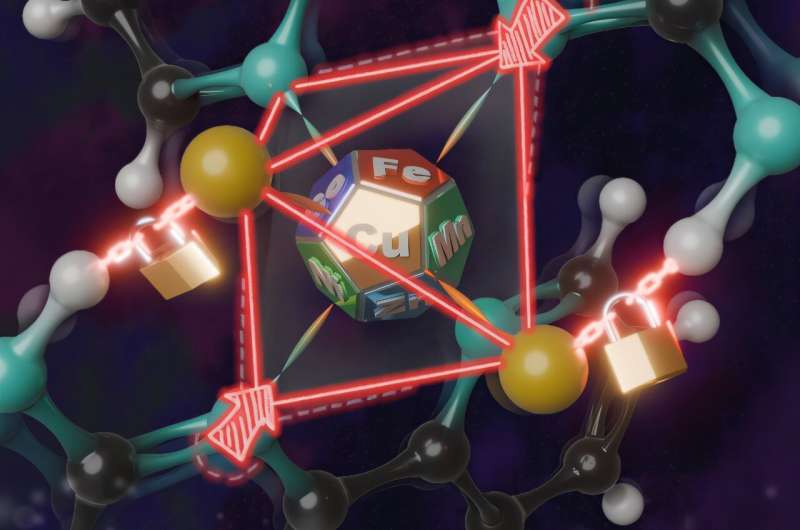
Copper has been knocked off the top of a stability ranking it had dominated for decades. Without altering the atoms directly bonded to the metal, a KAIST research team reversed the longstanding trend in which copper generally forms the most stable complexes by tuning only the weak hydrogen bonds in its surrounding environment. The findings, which appear in the Journal of the American Chemical Society, could open new avenues for selective metal separation and recognition, as well as catalyst design.
A research team led by Professor Yunjung Baek of the Department of Chemistry developed a “metal complex”—a structure in which several molecules surround and bond to a central metal—using a ligand based on the flavin framework found in vitamin B2. By tuning the hydrogen bonding around the metal, the team achieved a stability trend that runs opposite to the widely accepted Irving–Williams series.
The Irving–Williams series is an empirical rule that ranks how stably transition metals—such as iron, nickel and copper, which bond with other substances in a variety of ways—bind to surrounding molecules. Among manganese (Mn), iron (Fe), cobalt (Co), nickel (Ni), copper (Cu) and zinc (Zn), stability is generally known to increase from manganese toward copper, with copper forming particularly stable bonds.
This difference has been understood to arise from each metal’s electronic structure, meaning how its electrons are arranged. In other words, which metal forms the more stable complex has long been considered largely determined by the metal’s inherent properties.
Hydrogen bonds upend the usual order
Until now, changing this order typically required either designing a new ligand, the molecule that directly grips the metal, or altering the coordination structure, the way the metal bonds with surrounding molecules.
The research team instead focused on hydrogen bonding, a force that acts outside the direct metal-bonding region. Hydrogen bonds are relatively weak forces between molecules that help hold the surrounding structure in a fixed shape.
Using flavin derivatives, versions of flavin with part of their chemical structure modified, the team incorporated different metals ranging from manganese to zinc while ensuring that all the metals shared the same basic coordination geometry. By keeping the basic conditions around each metal identical, the researchers were able to examine what difference hydrogen bonding alone made to each metal’s stability.
The results showed that hydrogen bonding specifically blocks the structural change copper needs to become stable. Copper has a distinctive tendency to slightly reshape its surrounding bonding structure into a form that favors its stability, much like a person shifting slightly to find the most comfortable posture.
In the structure developed by the team, however, the surrounding hydrogen-bonded framework constrained the geometry around copper, preventing it from adopting its preferred distorted structure. As a result, copper lost much of the additional stabilization it would normally gain through structural distortion, producing what the researchers describe as an anti–Irving–Williams trend.
A route to selective metal capture
What matters most is not simply that copper was displaced from the top of the ranking, but that the study demonstrated that the relative stability of metal complexes, long regarded as being largely determined by the intrinsic properties of each metal, can be adjusted by changing the surrounding environment. For example, if a desired metal can be made to bond more strongly while others bond more weakly within a mixture, the principle could provide a basis for developing systems that selectively extract or recover target metals.
This principle could also be applied to catalyst design, where the surrounding environment is tuned so that a desired metal performs more effectively. Just as proteins and enzymes in the human body select the metal they need from among iron, copper, zinc and others, the approach is also expected to offer a new method for designing biomimetic systems that replicate the operating principles of living organisms to achieve a desired function.
Baek said, “The key point of this study is not simply that we lowered copper’s stability, but that we showed the order of bonding stability, long regarded as an inherent property of each metal, can be changed through the surrounding environment.” She added that the approach is expected to be used to design new chemical systems that selectively capture or react with a desired metal.
The research also drew attention at the International Conference on Coordination Chemistry (ICCC), held in Denmark. Haneul Im, a combined master’s and Ph.D. student in KAIST’s Department of Chemistry and the study’s first author, presented the work as a poster and was the only Korean student to receive a Best Poster Award.