

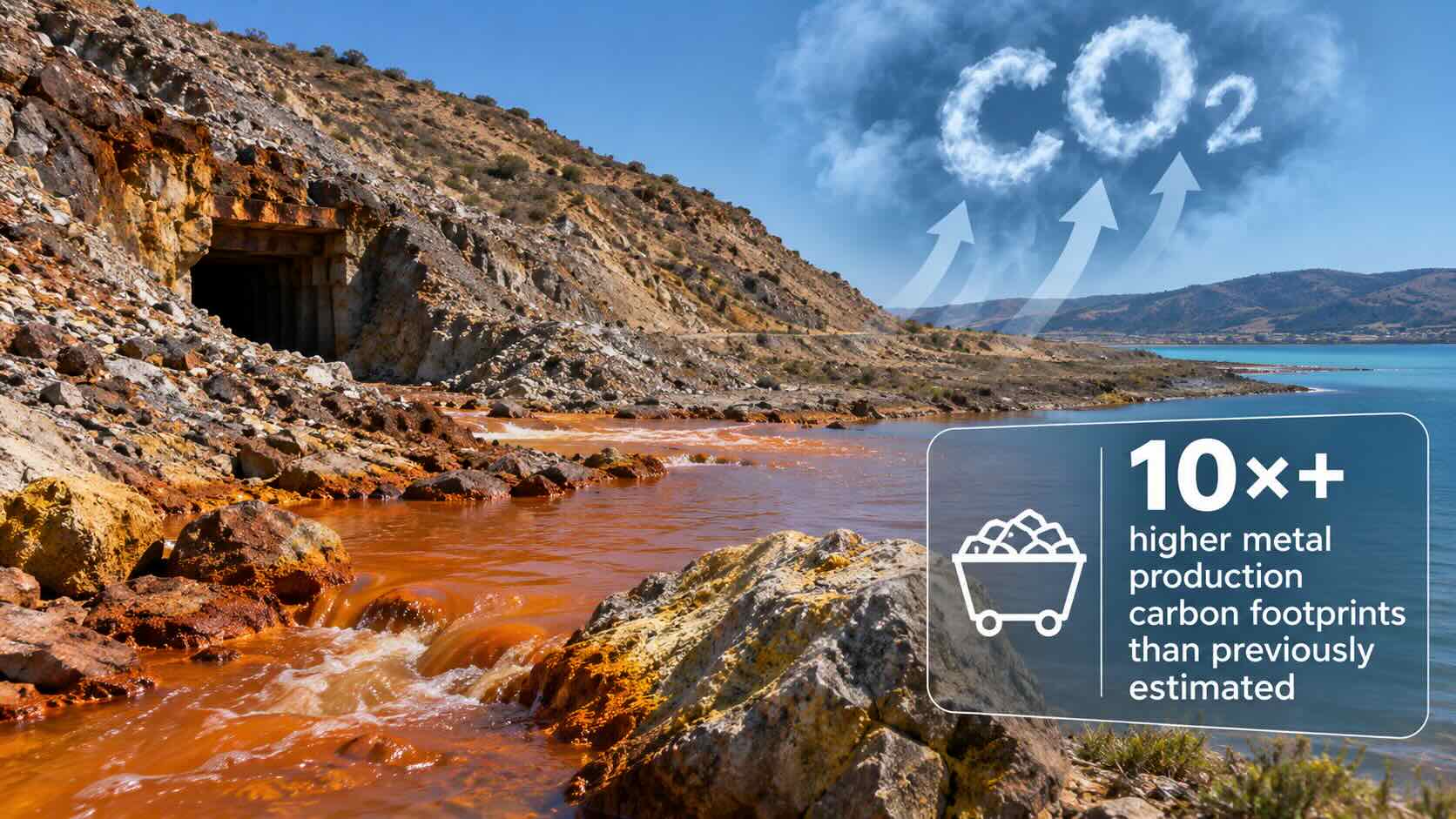
New research from the University of St Andrews has found that metal production carbon footprints could be more than 10 times higher than previously estimated, with serious implications for the ambition to reach net zero.
Published in Environmental Science and Technology, this work is the first comprehensive quantification of CO2 emissions from acid mine drainage neutralization for metal mining in academic peer-reviewed literature.
Acid mine drainage is a common and well-known side effect of mining, occurring when water-draining mining areas become acidic and full of toxic metals. It occurs when mining exposes a certain type of mineral (metal sulfides) that then reacts with oxygen-rich surface waters.
The subsequent interaction of these acidic waters with the surrounding environment can lead to chemical reactions that release CO2. Efforts to remediate this pollution often also involve reacting acid mine drainage with minerals in engineered settings, again releasing CO2. This chemistry is already known, but until now, no one had quantified the size of this CO2 emission source in detail.
Tracking emissions in southeast Spain
Researchers studied an area containing 82 historic or currently operating mines in southeast Spain that is considered to generate the highest rates of acid mine drainage in the world. They measured the chemistry of rivers draining this region to quantify the amount of acid mine drainage generated and how it is neutralized, which in turn allows estimation of the CO2 flux.
Researchers also measured how the chemistry of these rivers changes as they mix with alkaline seawater in the downstream estuary, again leading to CO2 emissions. This was further supported by laboratory experiments simulating river water-seawater mixing.
Results showed that, when all this was considered, acid mine drainage neutralization to date has emitted a similar amount of CO2 as the estimated conventional copper production carbon footprint from this region.
However, the problem is further compounded because acid mine drainage emissions continue to occur for a very long time after mining activity ends. This is because the metal sulfide minerals exposed during mining can take centuries to millennia to fully react with oxygen-rich surface waters, continuing to produce acid mine drainage far into the future.
The senior author of the project, Dr. Luke Bridgestock from the School of Earth and Environmental Science, said, “This is a shocking result. We estimate that the full emission budget for acid mine drainage by the time all the extracted sulfides have ‘weathered’ to produce acid mine drainage will be more than 10 times higher than conventional carbon footprints for copper production.
“This presents a challenge for reaching net zero greenhouse gas emissions given the need for increased metal production to supply green technologies. It’s essential that we now look at changing how acid mine drainage is remediated to reduce these emissions.”
A long-term burden for mining
This poorly accounted-for emission source will dominate the total carbon footprint of copper production in this region in the long run. While the size of this emission source is likely to be lower in other mining regions, these results highlight the importance of accounting for it across the metal mining sector.
Metal mining is set to rise to support the green transition. Given the role of metal production in supplying green technologies—solar and wind power, and increased electrification of the grid—decarbonizing the metal production sector is a key part of the strategy to reach net zero. This wider context provides added motivation for quantifying this poorly understood metal mining emission source.
By – https://phys.org/news/2026-07-carbon-footprint-metal-production-higher.html