

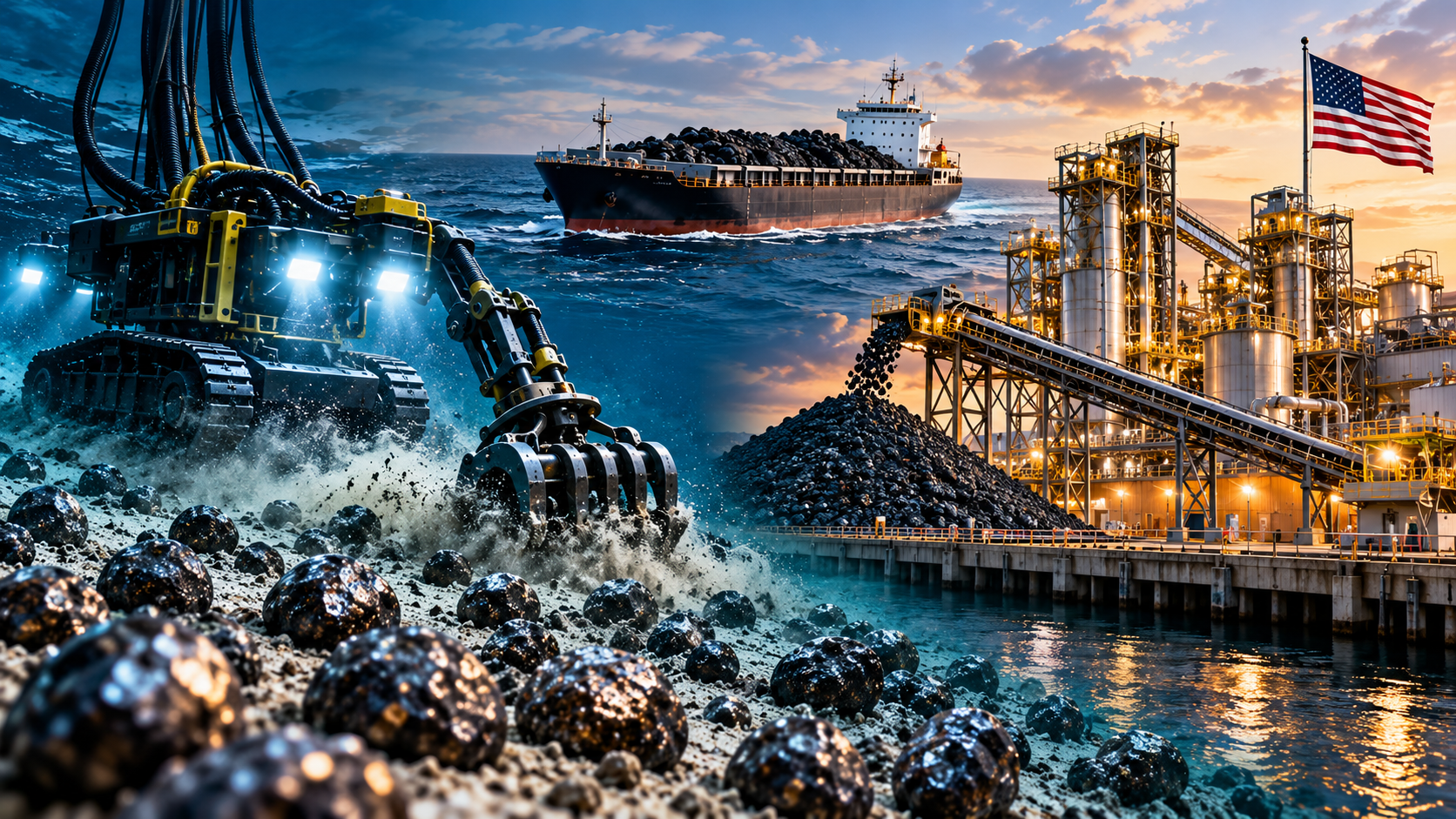
As federal authorities work to issue permits for mining in and beyond US waters, industry officials are making plans to build infrastructure the country lacks to process what’s recovered from the ocean floor.
Interior Secretary Doug Burgum told a gathering of G20 energy ministers recently the US was months away from issuing its first deep-sea mining permits. Despite that timeline, the US has yet to figure out how it will refine the mineral-rich rocks, called polymetallic nodules, for use in technology ranging from electric-vehicle batteries, defense systems, smartphones, and medical equipment.
“A big part of any new mineral source, particularly seabed mining, is processing the resources,” said Tom LaTourrette, senior physical scientist at the global-policy think tank Rand Corporation. “All the mining in the world is not going to help us if you don’t have processing capacity.”
The gap underscores a challenge underlying the Trump administration’s drive to counter the critical-minerals supply chains dominated by China, which controls roughly 90% of global processing capacity.
Although no ground has broken on any processing facility, companies have expressed interest in helping the US build its capacity.
The Metals Co., Deep Sea Minerals Corp., Impossible Metals Inc., and Glomar Minerals Inc. have each announced early-stage agreements with others to build out the nation’s first polymetallic-nodule processing capabilities.
Industry Plans
On Sept. 23, Deep Sea Minerals Corp. — whose US subsidiary is applying for a deep-sea mining permit — announced a nonbinding agreement with the American nickel-refining company Westwin Elements Inc. to evaluate potential US-based processing routes for polymetallic nodules.
“It’s going to be several years until, if awarded a license and a commercial recovery permit under NOAA, there would be production from our areas,” the company’s CEO, James Deckelman, said in an Aug. 28 interview. “In that time, we do see processing opportunities developing and to that extent we are in conversations with certainly more than one US-based processor that is seeking feedstock for their processing facilities.”
American critical minerals company Glomar Minerals Inc. and Australian-based Cobalt Blue Holdings Limited are weighing sites in Louisiana, North Carolina, and Texas for a project to refine 200,000 tons of nodules annually.
Glomar COO Craig Ferguson said their facility is aiming for “pilot scale” capacity to ensure feasibility, and aims to “address the vulnerability of the American critical mineral supply chain.”
The Metals Co., seeking a consolidated exploration and commercial recovery permit, presented at an Aug. 13 earnings call a Brownsville, Texas, site where it holds an exclusive right of negotiation over a lease option for nearly 1,500 acres of land to build a facility.
TMC plans to ship polymetallic nodules from the Clarion Clipperton Fracture Zone — an area in the Pacific Ocean between Hawaii and Mexico that has drawn interest from numerous companies — through the Panama Canal to the Port of Brownsville for processing.
But “no investment decision has been made and any future capital commitment would remain contingent on US government support,” TMC CEO Gerard Barron said during the call, according to a transcript.
When asked to specify expected government support, Barron said TMC highlighted for the administration that the US lacks facilities and that options in Asia were limited, with many under Chinese ownership or operating at different environmental and safety standards.
The Trump administration has also taken equity stakes in several private mining and critical mineral companies.
“The playbook that you’ve seen on other transactions will be a similar playbook to ours,” Barron said in a Tuesday interview, adding TMC is engaged in conversations with three government agencies that “have expressed willingness to fund this.”
‘Chicken or the Egg’
Some outside the industry remain skeptical about the deep-sea mining companies’ ambitions.
The economics remain unproven, said Aaron Mintzes, deputy policy director and senior policy counsel at the nonprofit Earthworks, adding that he questions whether the processing debate is getting ahead of itself.
“In 10 years, we’ll realize that there are cheaper sources for the materials we need than deep-sea mining, and so it won’t be a good investor prospect anymore,” Mintzes said.
Erik Milito, president of the National Ocean Industries Association, compared the processing gap to the early days of oil and gas development, where refineries weren’t built before a guaranteed supply of crude.
“This is a bit of a chicken or the egg dilemma,” Milito said. “The closer you get to commercial development and commercial licensing and commercial extraction, the closer you’re going to get to seeing those facilities built here in the US.”
Processing Abroad
Should the US processing capacity not be ready by the time companies receive permits, TMC says it’s ready to ship them abroad, with Barron pointing to a partnership with Japanese Pacific Metals Co. Ltd.
In response to an inquiry from two Japanese environmental and social justice groups, however, PAMCO in June said the company didn’t have a contractual relationship with TMC regarding commercial scale nodule processing and that it wouldn’t conduct new business that violated laws and regulations.
Barron said TMC is familiar with PAMCO’s comments, and “they continue to work with us and they continue to want to be involved in this industry.”
Companies interested in recovering polymetallic nodules from waters beyond national jurisdiction, or in the high seas, must apply through the Deep Seabed Hard Mineral Resources Act, or DSHMRA, under the National Oceanic and Atmospheric Administration.
Under the DSHMRA statute, all processing is required to be conducted domestically, but the law also provides for the NOAA administrator to allow exceptions to this provision.
Rebecca Campbell, a partner focused on the mining and metals sector at White & Case LLP’s London office, said “it’s impossible” for every country, including the US, to “build its own supply chain in all of these minerals” — and that shipping minerals beyond the US will build global alliances that would lessen reliance on China.
“At the minimum it will pluck the gap whilst the domestic processing capacity is being built up,” Campbell said.