

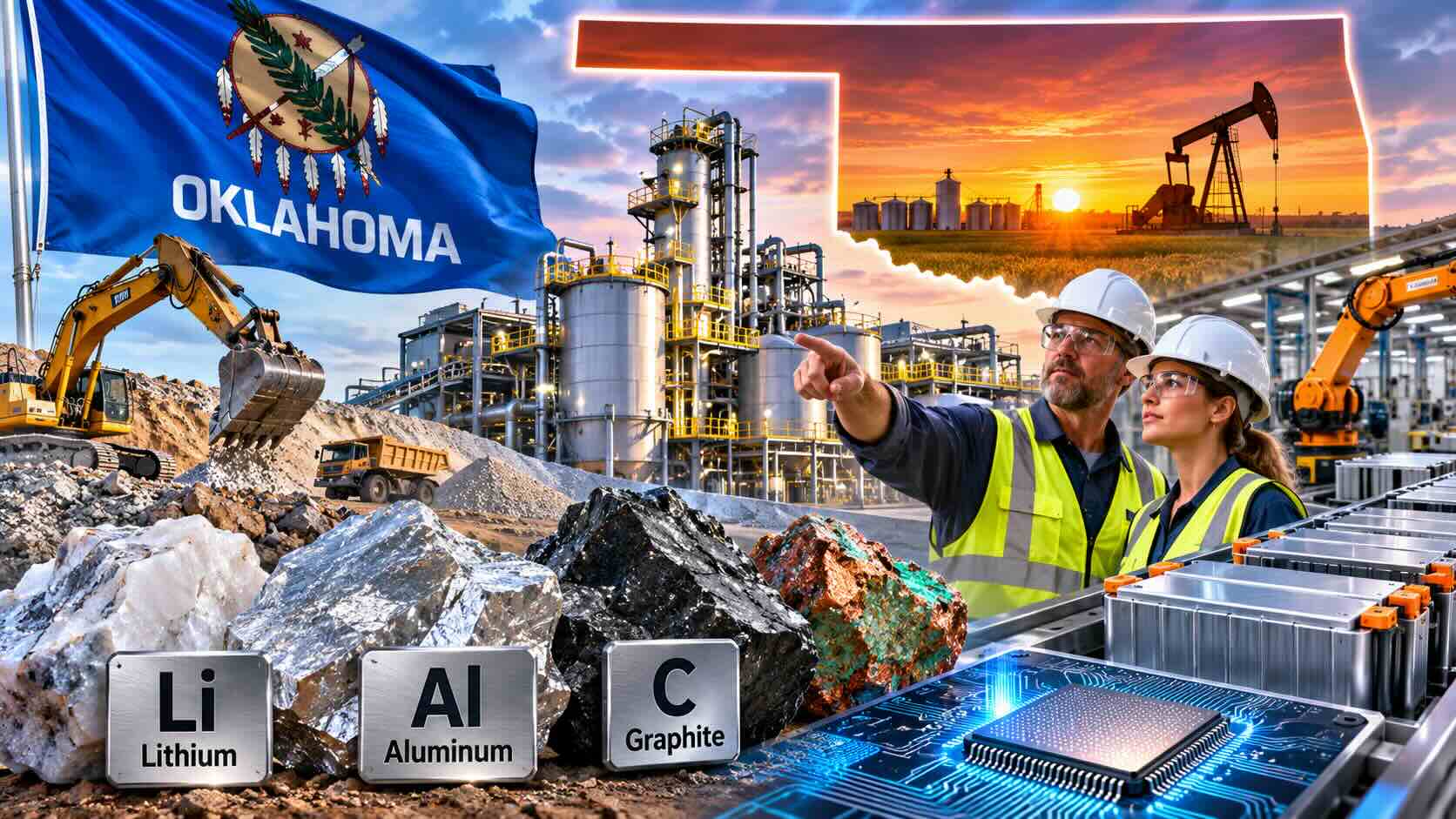
Oklahoma offers the resources, infrastructure, and workforce to build a stronger U.S. critical minerals supply chain.
As efforts around strengthening our domestic critical-mineral supply chains evolve, it is more important than ever that the U.S. adopts a strategy that doesn’t stop at what comes out of the ground: the U.S. also needs processing and manufacturing capabilities to turn those materials into products here at home.
Oklahoma might be the best example of how states with the resources, infrastructure, and workforce to support these activities can contribute to that broader effort.
The critical minerals our nation’s largest businesses rely on, including lithium, aluminum, and graphite, require extensive refining processes to break them down into their most basic chemical forms before they can be reconfigured into products such as semiconductor chips or batteries.
Historically, the United States has relied on partnerships with foreign countries, including China, to process raw materials into components that can then be turned into final products. However, as tensions around foreign trade escalate, it is essential to strengthen the capacity to process and refine these minerals here at home.
Oklahoma provides a case study in how advanced manufacturing and mineral processing can strengthen the domestic supply chain. Investments from USA Rare Earth and Stardust Power, among others, demonstrate how different parts of the critical-minerals and advanced-manufacturing ecosystem can develop within the same state.
USA Rare Earth operates a rare-earth magnet manufacturing facility in Stillwater, Oklahoma, to produce magnets used in electric vehicles, defense systems, semiconductors, and other advanced technologies.
As for Stardust Power, the company is developing a central lithium processing facility in Muskogee, Oklahoma, with the anticipated capacity of up to 50,000 metric tons per annum of battery-grade lithium carbonate for the battery and energy-storage supply chains.
These projects are supported by the state’s existing energy resources, infrastructure, workforce, and industrial base, creating conditions for companies not only to start but expand operations in the United States.
While they are not intended to replace crucial international supply chains, they can help strengthen the domestic capabilities that support them.
What it takes to build a domestic critical minerals ecosystem
A domestic supply chain isn’t a single facility or stage of production. It’s an integral part of a larger ecosystem in which each part needs the others to function, and extraction from the mine is only the beginning.
When critical minerals are first pulled from the ground, they are found in a state of ore concentrate and are mixed with other rock and minerals. For rare earth minerals to become usable to manufacturers, they must be refined to meet purity standards and broken down into their individual chemical compounds to isolate the targeted mineral.
This requires manufacturers and processors that are capable of turning those refined minerals and compounds into usable components or products, making solid infrastructure behind these processes just as important as mining for the critical minerals.
Processing and manufacturing facilities also require reliable access to energy, water, and transportation corridors. With Oklahoma’s industrial energy rates 20%-40% below the national average and over 400 miles of waterways connecting Oklahoma to the Mississippi River and the Gulf of Mexico, the state is primed to provide affordable energy for these projects as well as a sturdy logistical supply chain to move minerals.
However, there would be no processes to support and uphold without the base of a strong workforce.
Critical mineral processing and advanced manufacturing require employees with experience in areas such as chemical processing, engineering, equipment operation, and industrial maintenance. As more companies invest in these capabilities, developing a workforce with the technical skills to support increasingly specialized operations will be important to maintaining growth.
A company processing one critical mineral may create demand for nearby manufacturers, suppliers, or recycling operations, while existing industrial infrastructure and workforce capabilities can make a region more attractive to companies considering new investments. Over time, these connections can help create a more complete domestic ecosystem rather than a collection of individual projects.
Building a stronger domestic critical minerals supply chain will also require significant investment, and those investments must ultimately make economic sense for the companies and states involved.
Separation and refining of the materials represent a major share of total mine-to-product costs, as rare earths contain multiple elements that must be separated through highly complicated processes. Mining, crushing, milling, and chemical processing of these materials can also be energy- and water-intensive, adding higher operating and capital costs.
Rare earth projects also often face a “financing gap,” as developers must invest heavily in exploration, technology, and facilities before proving their performance. That means customers may hesitate to commit to long-term purchases until production has been demonstrated.
The next step: building resilience, not isolation
Strengthening domestic capacity does not mean the United States should view it as a replacement for international trade. Different countries have access to different mineral resources, technologies, and manufacturing capabilities, and the United States will continue to benefit from those relationships.
Attempting to develop every stage of every critical mineral supply chain entirely within the United States would be costly and, in many cases, unrealistic.
The goal should instead be greater resilience. By developing more processing, refining, and manufacturing capabilities at home, the United States can reduce its dependence on a limited number of foreign sources and have greater flexibility when disruptions affect global supply chains.
Domestic capacity also provides another option when international markets become more difficult to navigate, while maintaining relationships with international trading partners allows American companies to continue benefiting from resources and capabilities that are not available domestically.
That broader approach is already taking shape in places such as Oklahoma, where investments across different stages of the mineral supply chain offer one example of how domestic capacity can develop.
The state is working to become the next big hub for aluminum through the proposed aluminum smelter in Inola, Okla., which is estimated to bring $49 billion in cumulative economic impact through 2060 and includes more than 1,000 permanent direct jobs and 4,000-plus construction jobs.
The opportunity is not simply to produce more minerals, but to strengthen the connections between the resources, infrastructure, workforce, and industries needed to turn those materials into finished products.