

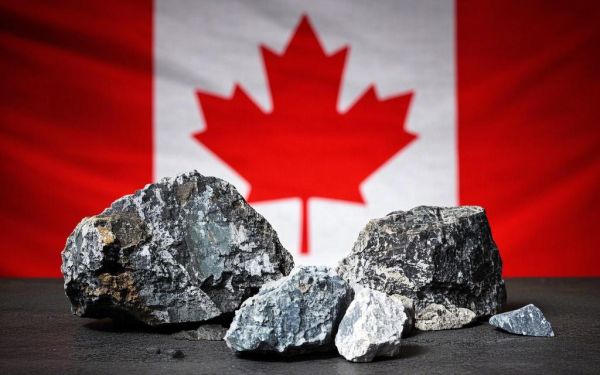
Despite Canada’s attempt to develop its own critical minerals industry, studies from the Royal Bank of Canada determines it needs to reassess its strategy.
As countries look to diversify their critical mineral supply chains away from China, Canada has been aiming to increase its own sourcing capabilities.
In order to grow its own critical minerals industry, Canada requires a much larger capital than what it is currently dedicating to this project.
If it can succeed, the country can support its own, and other Western nations’, attempts to diversify their critical minerals supply chains. A report by the Royal Bank of Canada (RBC) explores what Canada needs to do in order to develop sourcing strength.
A growing market
Critical minerals are raw materials that governments have labelled as critical in their economies. There is no singular list of these materials, as different countries have different definitions of what constitutes as critical and have different priorities within the materials they require.
Despite this, there are some common materials which are generally sought-after, including copper, lithium, cobalt and nickel.
As critical materials become increasingly desired – the demand for lithium has risen dramatically with the increase in EV production and the increase in renewable energy infrastructure has also altered material demand – countries are looking to change their sourcing patterns. Rather than relying on countries around the world to source and produce these materials, many countries are looking inwards and exploring their own mining capabilities.
According to the International Energy Agency (IEA), the critical minerals industry is expected to grow between to to three times globally. This will reach a capital requirement of US$500-600bn by 2040.
Demand for six key commodities – cobalt, copper, graphite, lithium, nickel and rare earth elements – will grow as a result of changing patterns across industries such as electric vehicles, clean energy infrastructure, space, defence, manufacturing and electronics. This growing market is a great opportunity for countries around the world, but RBC states that Canada’s lack of patient, risk capital impacts its ability to solidify its attempts.
Barriers to scale
Despite Canada’s geology capabilities, it is still a small player within the industry. The RBC states it accounts for only 2% of the global supply of the six core metals. However, it could grow to 14% of total supply over the next 15 years, according to the Canadian government – however, this relies on the country’s ability to fund its projects and prioritise its opportunities.
Out of the Western countries looking to diversify their operations, Canada has the highest capabilities to act. In Quebec and Ontario, it has high-grade lithium belts and graphite deposits.
In Manitoba, it has significant levels of nickel resources, as well as competitive copper reserves in British Columbia. It also has rare earth element capabilities spread across Newfoundland, Labrador and other areas of Canada.
Despite this, the country’s critical minerals sector is undercapitalised, with a strong need to close the gap. Some of the key issues include:
Lack of direction – in the past 25 years, only 11% of Canada’s mining capital has been directed to critical minerals development. Instead, most money has been directed to the mining of other metals, with goad and precious metals accounting for 70%. In contrast, Australia directed twice as much capital to critical materials in the same period.
Lack of domestic players – only 19% of Canada’s publicly listed S&P/TSX Composite mining firms are diversified miners, demonstrating poor diversity across its own operations.
Refining deficits – Western countries do not have the infrastructure for refining and processing, with China controlling 70% of the global refining market share for 19 out of 20 most critical minerals. Similarly, Canada only has one remaining active copper smelter/refinery.
Opportunities for growth
Canadian companies need to scale capital across the value chain – the Canada Growth Fund (CGF) has made three mineral investments, including to Thompson Nickel Mines in Manitoba, and has also invested in Quebec’s Nouveau Monde Graphite facility.
This demonstrates strong sovereign commitment, but there is still more capital needed in order to make significant changes.
Through building mineral corridors and sharing processing infrastructure, multiple problems can be solved at any given time. For example, the lithium projects can support regional refining hubs. Corridor economics could also extend to logistics, transport and other amenities.
Through shared projects and stronger corridors, projects are more financeable as well as more sustainable.
Canada can also close its capital gap by strengthening relationships with the US, according to the RBC. The US government is currently investing heavily in its defence and industrial supply chains – by forming a partnership, Canada could become a key supplier for the country.
However, it should still maintain a strong diversification strategy by also forming alliances with European and Asian countries.
By – https://miningdigital.com/news/canadas-critical-minerals-push