

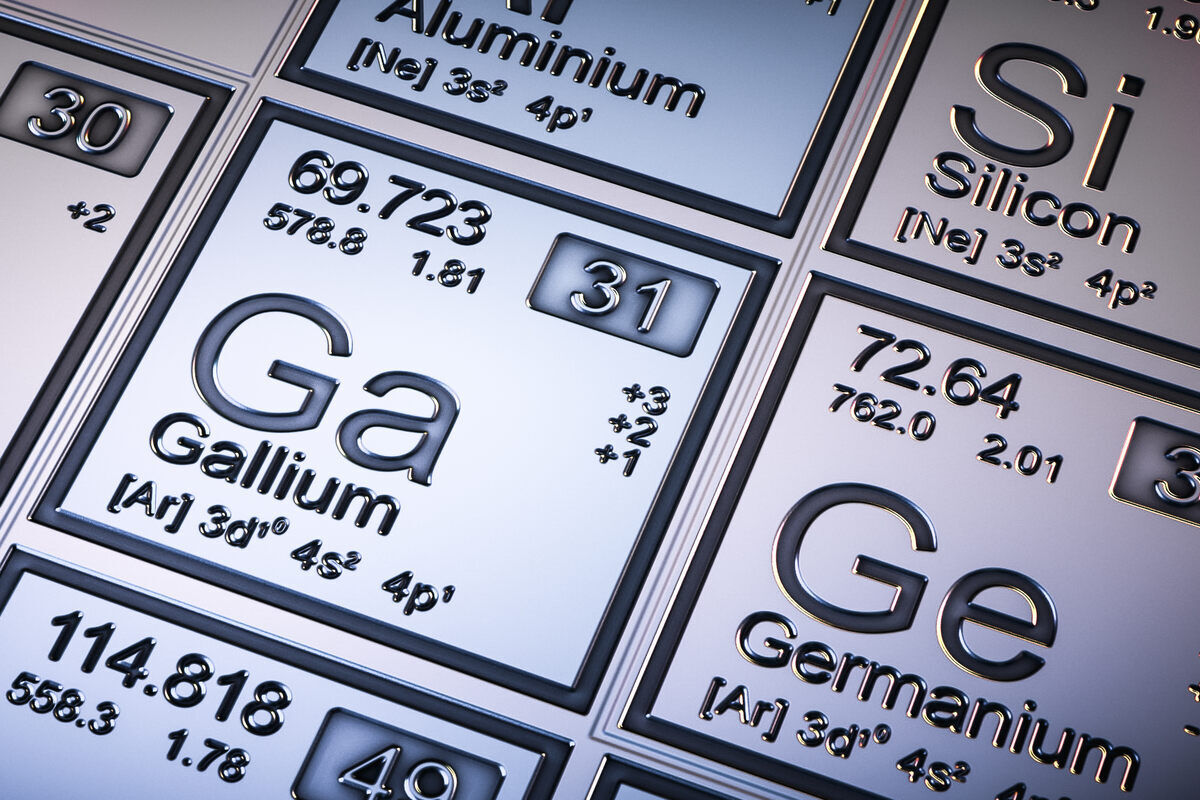
America’s heavy reliance on China for gallium and germanium – two obscure but increasingly strategic technology metals – is driving a new generation of domestic extraction technologies aimed at reshoring critical mineral supply chains.
One of the latest efforts is a newly announced partnership between Found Industries, whose Found Metals division is developing critical metals recovery technology born out of America’s gallium supply vulnerability, and ARES Strategic Mining Inc., owner of the only currently permitted fluorspar mine in the United States.
Under a memorandum of understanding signed by the companies, Found Metals will evaluate the recovery of gallium, germanium, and other strategic materials from feedstocks associated with ARES’ Lost Sheep Mine in Utah.
“ARES controls one of the unique domestic assets with the right combination of permitting position, critical mineral relevance, and multi-metal upside,” said Found Industries President and CEO Peter Godart.
Gallium is essential to advanced semiconductors, radar systems, LEDs, telecommunications equipment, and high-efficiency solar cells, while germanium is used in fiber optics, infrared optics, night vision systems, and next-generation electronics.
Concerns surrounding secure supplies of both materials intensified after China imposed export restrictions on gallium and germanium in 2023, highlighting the vulnerability of Western supply chains dependent on Chinese-controlled production.
That growing supply chain concern is what ultimately led Found Industries to establish Found Metals.
Originally focused on aluminum-fueled hydrogen generation technologies, Found Industries developed a gallium-catalyzed process that uses aluminum and water to generate hydrogen on demand.
While scaling the technology, however, the company encountered a major obstacle – China’s near-total dominance over gallium production and the tools required to process it.
“Gallium is the world’s most critical metal, as its 99% controlled by China,” Godart told MIT News. “When you produce 99% of something, you also produce 99% of the tools required to extract it.”
“We couldn’t get our hands on some of those tools, so we were forced to come up with a new technology,” he added.
That necessity-driven innovation led Found Industries to spin its aluminum fuel technology into Found Fuels and launch Found Metals to commercialize proprietary electrochemical extraction technologies designed to recover gallium, germanium, and other critical materials from complex and low-grade feedstocks.
“We thought of it as a way to future-proof what we were doing,” Godart told MIT News. “Necessity was the mother of invention.”
The company’s Direct Feedstock Extraction technology is designed to recover strategic metals from unconventional domestic sources such as tailings, leachates, industrial byproducts, and low-grade mineralized materials historically considered uneconomic or secondary opportunities.
Now, Found Metals sees potential to apply that technology at Lost Sheep.
“This collaboration gives us a pathway to demonstrate how next-generation electrochemical refining can help transform a strategic U.S. mine into a scalable, multi-metal critical materials platform,” Godart said.
America’s only permitted fluorspar mine
Located roughly 100 miles southwest of Salt Lake City, ARES’ Lost Sheep Mine is being developed as a domestic source of fluorspar, a largely overlooked mineral essential to steelmaking, aluminum production, lithium-ion batteries, semiconductors, refrigeration systems, and uranium processing.
The project has drawn growing strategic attention as the U.S. works to reduce dependence on foreign critical mineral supply chains.
In January, ARES announced a contract to supply up to $250 million of acid-grade fluorspar, also known as acidspar, to the U.S. Department of War over a five-year period. In February, the company announced the start of mining and stockpiling operations at Lost Sheep.
“We are proud to support the U.S. government’s strategic material reserves by supplying domestically sourced, high-grade acidspar,” said ARES President and CEO James Walker.
Under the MOU with Found Metals, ARES is now evaluating whether feedstocks associated with Lost Sheep may also offer the potential to recover gallium, germanium, and other high-value critical materials.
“Fluorspar is already a critical mineral,” Walker said. “The opportunity to evaluate gallium, germanium, and other high-value critical materials from the same broader resource base could make Lost Sheep even more important to North American supply chains.”
The initial phase of the collaboration will focus on characterizing the feedstock and evaluating the technical and economic viability of applying Found Metals’ extraction technology at the site.
If successful, the companies say the partnership could provide a pathway toward pilot-scale operations, commercial deployment, and the broader application of electrochemical extraction technologies across domestic critical mineral projects.
“The market is rewarding speed, differentiated process economics, and strategic supply relevance,” said Godart. “We believe this collaboration with ARES has all three ingredients.”
Beyond Lost Sheep, the commercialization of technologies capable of economically recovering critical minerals from unconventional feedstocks could help unlock new domestic sources of materials essential to semiconductors, defense systems, energy technologies, and advanced manufacturing.
As the U.S. looks to reduce its dependence on foreign supply chains increasingly shaped by geopolitical tensions, projects that combine domestic mineral resources with innovative extraction technologies are drawing growing attention from industry, investors, and policymakers alike.