

Alaska Gov. Mike Dunleavy is taking his case for developing the state’s vast critical mineral resources to a national audience, arguing that Alaska could help break America’s heavy reliance on China for the raw materials behind advanced technologies and national defense.
“Here in Alaska, our state hosts resources of 57 of the 60 most important critical minerals,” he stated in an op-ed published by Fox News titled “China is holding critical minerals hostage. Alaska can help end the threat.”
The long list of critical minerals Dunleavy says are found in Alaska includes antimony for military hardware and high-tech applications; gallium and germanium for semiconductors, energy and telecommunications; graphite for electric vehicles and energy storage; and rare earth elements for hard drives, smartphones, robotics and EV motors.
While Alaska and other parts of the U.S. host rich stores of critical minerals, American manufacturers continue to rely heavily on imports for many of the commodities essential to the nation’s economy and security.
According to the U.S. Geological Survey’s 2026 Mineral Commodity Summaries, the U.S. was 100% reliant on imports for 13 of the mineral commodities on the nation’s 2025 critical minerals list and more than 50% import-reliant for another 20. China was the leading supplier of eight of these highly import-dependent minerals and a major supplier of six others.
China’s influence extends beyond U.S. imports. The country is the world’s leading producer of many critical minerals and dominates substantial portions of the processing and manufacturing capacity that converts mined materials into the products needed by advanced technology supply chains.
“We offshored our national security to places like China when it comes to critical minerals and other strategic metals,” Dunleavy told hosts of Fox Business’ “The Bottom Line.”
The Alaska governor argues that this dependence presents risks to both America’s economy and national defense.
“It’s not an exaggeration to say that, without access to the critical minerals that form the backbone of our modern technological infrastructure, our economy would face major challenges growing and sustaining new jobs and equipping our military with the systems that keep us safe,” he wrote.
Dunleavy also contends that relying on countries with less stringent environmental and worker-safety standards simply transfers the impacts of mineral production overseas.
“In Alaska, we do development and take care of the environment probably better than anywhere else on the planet,” he responded when The Bottom Line hosts asked if Alaska could supply critical minerals while protecting the state’s natural beauty.
The Alaska governor pointed to graphite as one of the high-priority critical minerals that the state could begin delivering into American supply chains.
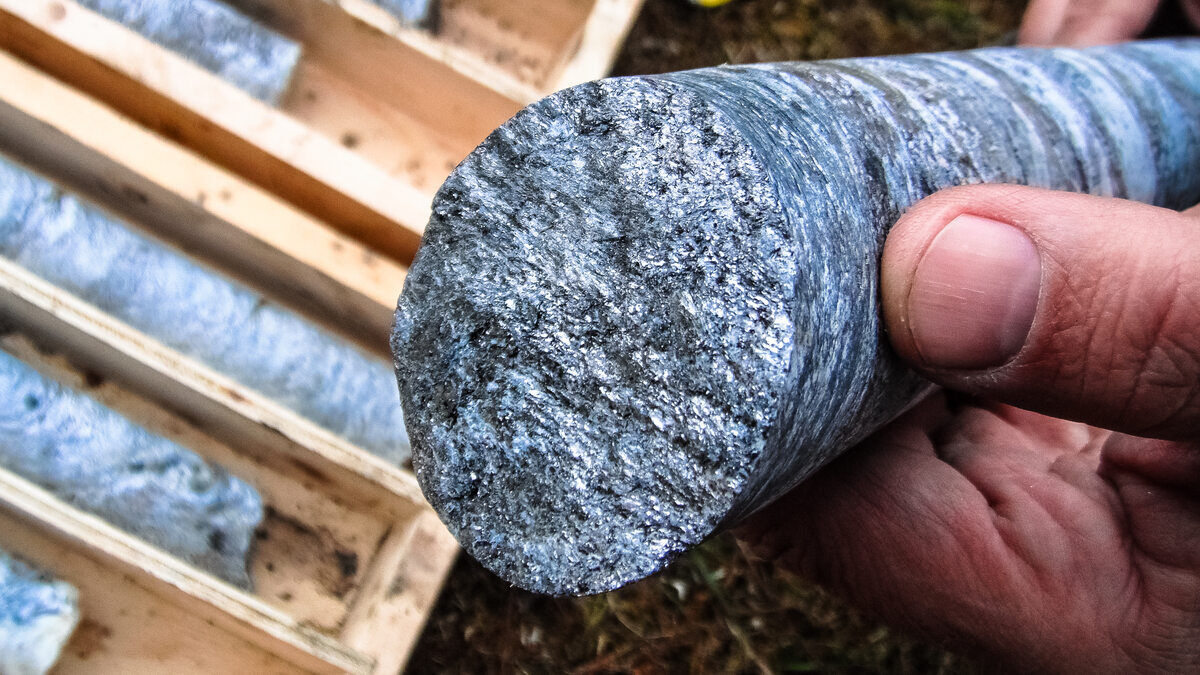
“Among its many mineral deposits, Alaska holds a bountiful reserve of graphite in the aptly named Graphite Creek Project,” he wrote. “New estimates suggest that this one reserve alone could provide enough graphite to meet the entire nation’s needs for a century.”
Graphite Creek, which is located about 35 miles north of Nome, is being advanced by Vancouver-based Graphite One Inc. as the mine end of a vertically integrated U.S.-based graphite supply chain.
The strategic importance of that domestic resource is underscored by America’s current dependence on foreign graphite.
According to USGS, the U.S. remains 100% net import-reliant for natural graphite, while China accounted for an estimated 82% of global natural graphite production in 2025. China’s dominance tightens farther downstream, with the International Energy Agency reporting that the country produces more than 90% of the anode active material used in electric vehicle batteries.
Graphite One plans to connect the proposed Alaska mine with an advanced graphite and battery anode materials plant being developed in Ohio.
The company is taking a phased approach to the Ohio facility. Current plans call for roughly 10,000 metric tons per year of anode active material finishing, coating, and blending capacity to begin operating in late 2027, followed by 25,000 metric tons per year of synthetic graphite and graphitization capacity targeted for late 2028.
Graphite One currently targets natural graphite production from Graphite Creek beginning in 2029, subject to permitting, regulatory approvals, and financing. The Alaska project is moving through the federal permitting process under the FAST-41 program.
The company is also considering potential battery material recycling operations at its Ohio complex, which could add a circular component to its domestic graphite strategy.
“Graphite One is advancing a fully integrated U.S. supply chain…designed to transform a world-class American resource into secure American supply,” said Graphite One President and CEO Anthony Huston.
At full buildout, the Ohio plant is designed to produce roughly 169,000 metric tons of battery anode material annually, along with additional purified and industrial graphite products. That amount of anode material would be roughly enough for the batteries in 2 million medium-range sedan-sized EVs.
“If America is serious about reducing its dependence on foreign graphite, domestic resources must be developed at scale,” Huston added. “That is what Graphite One is being built to do.”
The federal government has already placed strategic weight behind the project.
In 2023, the U.S. Department of Defense awarded Graphite One’s Alaska subsidiary $37.5 million under the Defense Production Act to accelerate completion of the Graphite Creek feasibility study and expand domestic graphite production capacity. The Pentagon described graphite battery anodes as an essential national defense technology item.
Dunleavy contends that the U.S. needs to invest more heavily in domestic supply chains like the one Graphite One is attempting to establish.
“Not developing projects like Graphite Creek amounts to waving the white flag of surrender to China in our contest to shape the future of the world economy,” the Alaska governor stated. “Its Communist government has already used critical minerals to engage in economic blackmail, holding access to the minerals hostage to protest American trade policy. Americans should never agree to this extortion – and, by developing our own American resources, we need never do so.”
He argues that Alaska provides an attractive alternative not only because of its mineral resources but also because of its strategic location and abundance of natural gas and other energy resources.
“If we can get some processing and refining happening…here in Alaska, the shipping routes to our friends in Asia and the Lower 48 are relatively short,” he said.
Dunleavy’s argument dovetails with President Trump’s January 2025 executive order, “Unleashing Alaska’s Extraordinary Resource Potential,” which directs federal agencies to facilitate development of the state’s energy and mineral resources.
The order states that unlocking Alaska’s natural wealth would help “enhance our Nation’s economic and national security for generations to come.”
For Dunleavy, Graphite Creek offers a tangible example of how Alaska’s mineral wealth could be transformed from resources in the ground into the domestic supply chains Washington increasingly considers critical to America’s economic and national security.