

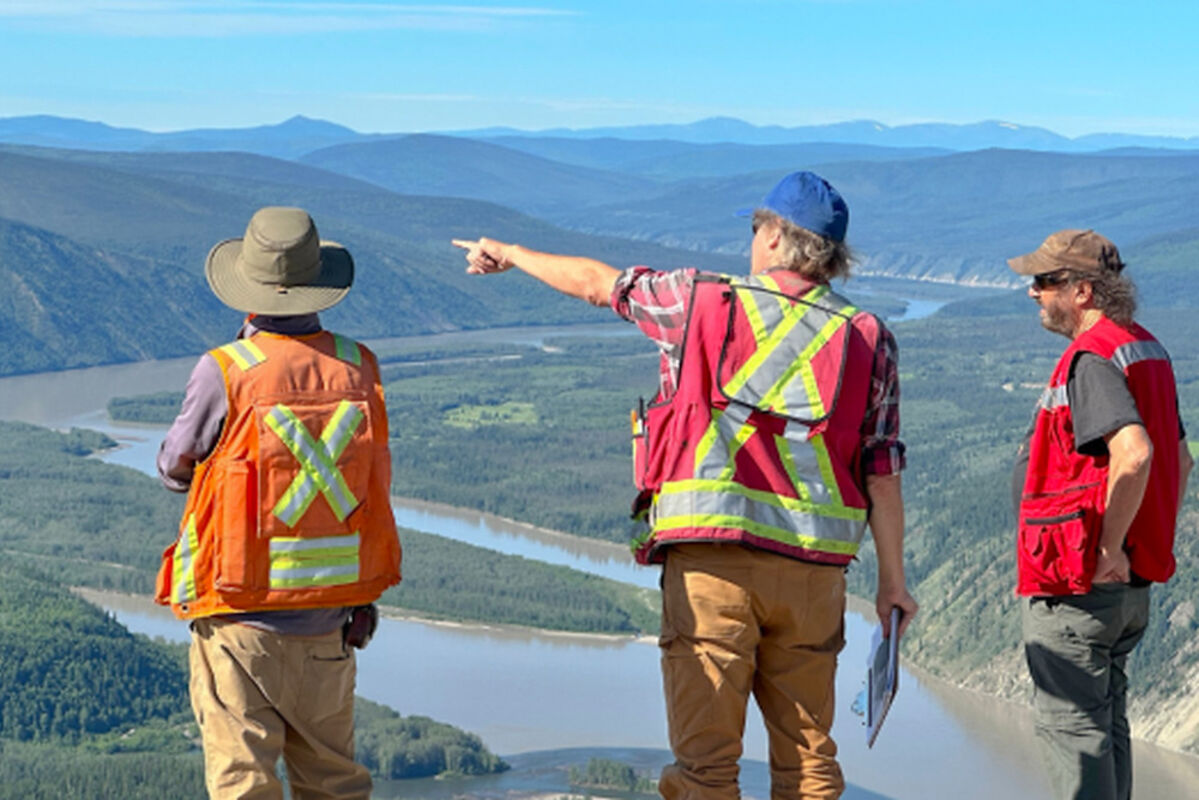
Lone Star and Stander drilling aims to expand gold resources.
Klondike Gold Corp. May 26 reported that its 2026 diamond drilling program is underway at the Klondike District Gold Project in Yukon, where the company is working toward an updated and expanded gold mineral resource estimate that builds on a calculation completed in 2022.
Located roughly 20 kilometers (12 miles) southeast of Dawson City, the Klondike District Gold Project spans 727 square kilometers (281 square miles) of the historic Klondike placer district, where more than 20 million ounces of gold have been recovered since the late 1800s.
According to the 2022 calculation, the Klondike District Gold Project hosts 21.59 million metric tons of pit-constrained indicated resource averaging 0.68 grams per metric ton (468,901 ounces) gold; plus 6.46 million metric tons of inferred resource averaging 0.54 g/t (111,959 oz) gold across the Lone Star and Stander zones.
Since that estimate, drilling, relogging, structural mapping, and geological modeling have continued to refine Klondike’s understanding of how gold mineralization is controlled across the property, shifting the company toward a more targeted effort to expand known zones and test extensions beyond the existing resource model.
During the 2025 field season, Klondike advanced that work through a multi-phase program that first tested structural controls along the Eldorado Fault Corridor before shifting back to the Lone Star and Stander areas, where drilling and reinterpretation work began outlining targets for a larger 2026 resource expansion program.
Results from that campaign included multiple mineralized intercepts outside the existing resource model, with 500-plus-meter step-outs southeast of Lone Star that the company said provided firm targets for 2026 drilling aimed at a significant expansion of the zone. Highlights from the 2025 drilling and related core review include:
• 80.5 meters averaging 0.6 g/t gold from near surface in LS25-572, including 13 meters averaging 2.67 g/t and one meter averaging 19.17 g/t gold.
• 35.5 meters averaging 0.98 g/t gold from a depth of 84.5 meters in LS25-567, including 0.5 meters averaging 28.67 g/t and 0.5 meters averaging 8.87 g/t gold.
• 12.5 meters averaging 2.57 g/t gold from a depth of 96.5 meters in LS25-568, including one meter averaging 23.74 g/t gold.
• 4.5 meters averaging 1.56 g/t gold from a depth of 78 meters in EC25-578, including 0.5-meter intervals averaging 5.52 g/t and 4.79 g/t gold.
• 64.1 meters averaging 0.29 g/t gold in LS22-492, including 0.5 meters averaging 6.53 g/t and 0.6 meters averaging 3.17 g/t gold.
Carrying that work into 2026, Klondike expects the initial fully funded campaign to include roughly 8,000 meters of diamond drilling across priority targets at Lone Star, Stander, and adjacent prospective areas, with completion anticipated by July.
An additional phase of up to 5,000 meters of diamond drilling is planned later in the season, following assessment of the initial results.
“Our 2026 drilling campaign marks an important step toward advancing and growing the gold resources outlined in the 2022 MRE,” said Klondike Gold President and CEO Peter Tallman. “We believe significant opportunities remain to expand mineralization along strike and at depth within the district-scale property package, including follow-up on results from 137 additional drill holes totaling more than 19,000 meters reported subsequent to the 2022 resource estimate. This program is designed to systematically unlock additional value while advancing the project toward future development studies.”
Focused on known mineralized zones, infill drilling, and extensions of near-surface gold mineralization along Klondike’s broader structural corridor, the 2026 program is designed to both expand the current resource base and increase confidence in areas already outlined by previous drilling.
In addition to resource expansion work, Klondike said the program will collect geological, structural, and metallurgical data intended to support future engineering and economic evaluations.
Assay results from the 2026 program are expected to be released on an ongoing basis throughout the exploration season.