

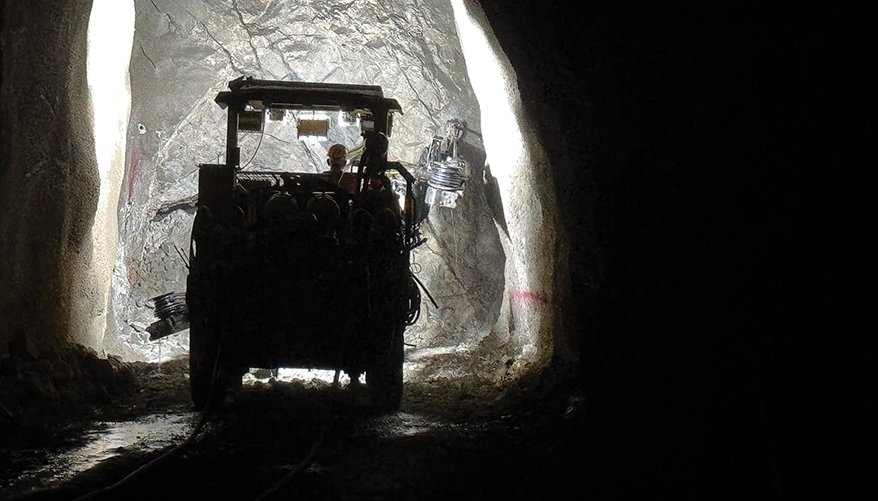
Deep in the heart of a mountain — about 200 kilometers southeast of Seoul — Benjamin Byun, assistant mine superintendent and survey manager at what was once — and soon will be again — the largest tungsten mine in the world, trained an ultraviolet light on a newly exposed wall of stone.
Appearing in the light beam were hundreds of thousands of blue speckles appearing in bands — like stars in the Milky Way.
“That’s tungsten,” Byun declared.
He was standing at the end of a gallery at the near conclusion of the long journey undertaken by Almonty Korea Tungsten Corp. to reopen the Sangdong tungsten mine over 30 years after it closed.
In the years after the Korean War, tungsten was a vital resource for South Korea as it rebuilt the nation, amounting to 70 percent of exports until the economy diversified, Byun explained during a tour of the Sangdong mine. But like many strategic minerals, China today dominates the tungsten market, currently controlling around 80 percent of annual production according to most calculations.
Earlier in 2025, China placed export controls on tungsten in retaliation for U.S.-imposed tariffs. The export restrictions had not been lifted at press time.
Tungsten’s story is a familiar one. Back in the 1980s, China started taking steps to corner the metal’s market by dramatically lowering prices. Declining profits drove the Sangdong mine — which had been producing the vital mineral since the Japanese colonial era — out of business.
A mine in Nevada suffered a similar fate. The mineral hasn’t been extracted in the United States since 2015, although there are steps being taken to remedy that.
The U.S. Geological Survey has tungsten on its list of 60 critical minerals that are deemed vital for national security and U.S. economic interests and are prone to supply chain disruptions.
The phrase “tungsten steel” is familiar to most people — it is needed to make the metal even harder — but it is also needed in a variety of critical technologies, not the least of which are semiconductors and common items like light bulbs.
Jaeheon Lee, an associate professor at the Colorado School of Mines and past chair of the Mineral Metallurgical Processing Division Executive Committee at the Society for Mining, Metallurgy and Exploration, said the mineral’s resistance to corrosion and the fact it has the highest melting point of any metal gives it myriad uses in the defense industry, including radiation and heat shielding, penetrating munitions, protective armor and heat sinks for high-end electronics that tend to grow too hot.
“In the U.S., there’s no active mine. … Like other critical minerals and rare earths, there is no sustainable supply chain in the U.S.,” Lee said in an interview.
Byun said tungsten is harder than steel and nearly as heavy as gold. It takes .04 grams of it to make a smartphone vibrate, 65 grams to make a stone hammer drill and 750 grams to make a movie theater projector work, according to a U.S. Geological Survey fact sheet.
Other defense industry applications include aircraft and rocket engines and 5G communication networks, Byun explained.
While the Sangdong mine has been idle for decades, it has what real estate agents call “good bones.”
It already had good drainage and ventilation systems and wide tunnels, Byun said. Work on restarting the mine under different owners sputtered since its closure in the 1990s, but got underway in earnest after Toronto-based Almonty Industries Inc. acquired the mining rights in 2015.
Once the mine reopens, workers will extract the tungsten and follow the seam up, using the tailings to rebuild the floor, Byun explained. There is an estimated 45-plus years worth of tungsten to extract — and as a bonus, Almonty has discovered another important metal, molybdenum, some 150 meters below the tungsten deposits.
[Editor’s Note: On Dec. 16, Almonty announcedthe first truckload of ore had been delivered to the Run-of-Mine pad at the Sangdong Mine, a pivotal transition from early-stage mine development to active mining operations and the final step before commencement of commercial production.]
Three freshly painted processing buildings will be where the ore will be crushed and then refined into a fine powder. Machinery made in Finland will smelt and process the tungsten, and Finnish technicians were on site fine-tuning the equipment.
Almonty has a three-phase plan, the first of which is nearly done — to get the mine back up and running — then exploit the molybdenum, and finally to establish the ability to refine tungsten oxides, a more pure, higher grade of the mineral, Byun said.
Tungsten has not been mined in the United States since 2015, according to the U.S. Geological Survey’s annual report on the metal for 2025. Yet, there are seven companies capable of converting concentrates and recycled materials into useful powders and chemicals for industry. Since these companies’ data is proprietary — and the survey had no figures available on the strategic stockpile — it had limited insights into the market. Statistics indicated that 27 percent of ore and concentrate imports into the United States originated from China, followed by Germany at 14 percent and Vietnam and Bolivia at 8 percent.
Lee said he knew of no strategic stockpile in the United States.
Lewis Black, founder and CEO of Almonty Industries, didn’t mince words when he laid the blame on U.S. companies — including the defense industry — for helping China corner the tungsten market by the 1990s.
These companies were all too happy to pay the lower prices and boost their profit margins, which indirectly led to U.S. mines and the Sangdong location closing.
“There were nearly 100 tungsten mines around the world [outside of China] in the 50s, 60s, 70s, and by 1993, there were two left,” Black said in a phone interview after the tour.
“China saw a huge opportunity. This was not ideology, this was just business, and they were enabled by an industrial base in the West,” he added.
One survivor was Almonty’s mine in Portugal — which the company has struggled to keep open over the years — but has managed to do so through innovation and by being a good supplier to long-time customers, he said.
“We had two choices back then,” he said. “We could have done what all the other mines did, which was complain to their government, saying, ‘This is horrendously unfair. What are you going to do about it?’ And of course, got no response.”
Almonty instead developed technologies and innovations to survive the low-price environment, although it was “touch and go over the years,” he added.
To avoid Chinese market manipulation, the South Korean government has guaranteed a price floor for tungsten coming out of Sangdong. Prices per ton are currently high, but if it goes under a certain point, Seoul will step in, Black said.
An informal agreement will see 45 percent of the mine’s supplies go to the U.S. market with a yet-to-be-determined percentage marked for South Korean companies, which are now entirely reliant on China, he said.
“Everyone wants this material for a number of sectors — defense being one of them — and there’s only so much that can go around,” Black said.
There is little left to do at Sangdong before it is 100 percent operational. Almonty needs to do a dry run on its processing equipment that crushes the rock and then refines it into a powder, he said.
Byun — during the tour of the mine and the processing plant — pointed to a pile of some 100,000 tons of tungsten-bearing rocks already extracted from the mine that will be used to test the equipment.
Black declined to name a date for the mine’s formal opening but said it was really just a matter of setting up a ribbon-cutting ceremony — most likely after the end of Korea’s notoriously harsh winter.
Meanwhile, there are two mines under development in Nevada, which are looking to start processing tungsten by end of the current Trump administration in early 2029.
In July 2025, the Defense Department under the Defense Production Act awarded Golden Metal Resources LLC — a wholly owned U.S. subsidiary of London-based Guardian Metal — $6.2 million to support the rapid advancement and pre-feasibility study for the company’s Pilot Mountain tungsten mine project. The company also has rights to mine a second location in the state, called Tempiute.
Guardian Metal CEO Oliver Friesen said in an interview: “What I think really sets us apart is we are focused on a mine that is an America solution. And I think that’s really important, because if you look at the supply chain, you know the processing capacity exists on U.S. soil, but the only thing missing right now is the domestic mine supply.”
Nevada is typically ranked number one or two in the world in terms of best jurisdictions to mine, he noted.
“We have two projects, both which are moving forward through the engineering stages right now, both which we believe can deliver commercial production before the current administration leaves office,” he said.
Pilot Mountain produced tungsten for the nation’s World War II arsenal.
Tempiute was once the largest operating tungsten mine in the United States until 1983 when China flooded the market with cheap tungsten, Friesen said. It still has a great deal of its infrastructure still in place, he added.
There are “whisperings” about a price floor similar to what South Korea is guaranteeing for Sangdong to prevent China from going back to its playbook on tungsten and other critical minerals, but nothing definitive yet, Friesen said.
“We would welcome having those conversations looking at the availability of price floors for tungsten, because obviously that’s a metal which has been weaponized in the supply chain,” he said.
Black, however, said price floors are not a long-term solution. What one administration gives, another could take away, he noted.
Nevertheless, Friesen said there has been a sea change in the attitudes during the Trump and Biden administrations when it comes to reigniting the U.S. critical mineral mining industries.
The Defense Department award to kickstart the Pilot Mountain project has helped, and at the same time, the new administration is expediting the permitting process, which is “tremendously important” in the mining industry, he added.
“I’ve never seen the tailwinds like what we’re seeing now,” he said.
After the pre-feasibility studies are completed later this year, the company will conduct a definitive feasibility study, which includes all detailed drawings for the mine.
“And then that brings us into early 2027, where we anticipate we would raise the construction capital,” he said.
The U.S. and South Korean tungsten mines aren’t the only ones making news this year. The United States and Kazakhstan struck a deal in November to develop a tungsten mine in the Central Asian nation. Mining investment firm Cove Capital will develop a tungsten deposit with the state mining firm JSC Tau-Ken Samruk.
Cove Capital will control 70 percent of the joint venture and sales of the metal, with Tau-Ken Samruk controlling the remaining 30 percent, according to a Reuters report. Costs to develop the mine are estimated at $1.1 billion, while the U.S. Export-Import Bank has issued a letter of interest to fund $900 million.
The deal was largely seen as a strategy to block Chinese companies from entering Kazakhstan’s tungsten market, the news report said.
Another source of the mineral is recycling.
Lee said: “The most difficult thing in recycling is collection. For the material that we use in a defense or military application, the collection is relatively easy.”
However, he didn’t know of any tungsten recycling ongoing in the United States.
“Maybe it’s not attractive for the private companies or investors,” he said. However, if the U.S. government got involved, that could kickstart a tungsten recycling stream, he added.
One factor in favor of the U.S. and South Korean projects, Friesen pointed out, is China’s diminishing tungsten capabilities.
“They’ve been mining a lot of tungsten for a lot of years. So, what that means is the easy to get to resources — the high-grade open pit stuff — is all gone, and now they’re going underground and going after lower grades. So, their ability to produce as much material is dwindling,” he said.
https://www.nationaldefensemagazine.org/articles/2025/12/18/mining-companies-squaring-up