

A group of monks piled into Harry Browne’s one-room cabin earlier this year for morning Mass. They left proof of their presence: a crucifix and a medal of St. Benedict.
Browne isn’t a member of their flock, but the group was brought to his property in the mountains north of Silver City by a shared concern about mining in and around southwestern New Mexico’s Gila National Forest.
Silver City is a historic mining town. But when hundreds of mining claims were staked in the Gila Wilderness and surrounding areas over the past year, the community pushed back. Arizona-headquartered copper and critical mineral company Ivanhoe Electric Inc. ultimately withdrew its plan for the area following local outcry, but another company, which mines metals like copper, aluminum and lithium around the world, appears to be considering mining development in the area.
A 1988 report by the U.S. Interior Department found the Gila Wilderness had high potential for manganese mining in some places, and lower potential for other metals, geothermal resources and oil and gas. Manganese is often used in steelmaking.
Browne, a former Grant County commissioner and longtime resident, said he’s seen the mining industry go through booms and busts, each leaving its footprint on Silver City. In recent years, he said the town has become less dependent on mining revenues from the Freeport-McMoran copper mines in the county, increasingly turning to tourism and the arts.
“The late ’80s were quite bad,” Browne said. “Lots of boarded-up shops. I wasn’t here then, [but] since then, it’s gone up and down a few times.”
Mining claims also have raised concerns among the Benedictine monks and nuns at Our Lady of Guadalupe Monastery, about nine miles north of Silver City. Mining — with some claims on the monastery property, surrounded by forest lands — would threaten not only their quiet lifestyle but also the forest, the Gila River watershed and the aquifer, they say.
A shift in the industry
Recently, Browne and others started finding new claim markers. Within hiking distance of his cabin, he found a film canister tied to a tree, which held a folded-up piece of paper with details of the claim. Looking at public records, he found five claims that overlapped with his property.
Browne said residents periodically found old mining claims that were never developed. This feels different, he said, with pro-mining shifts on the federal level and the development of new technologies that could tap previously unreachable resources.
“It’s way out of the ordinary,” Browne said. “But also perfectly logical given the administration in D.C.”
Browne, the co-founder and former executive director of the Gila Resources Information Project, said he spent the first eight years running the organization working on mining issues. New Mexico implemented a strong mining law, he said — but initially, it wasn’t being enforced.
He donned a baseball hat embroidered with a coatimundi, a striped-tail raccoon-like mammal that lives in the Southwestern United States, Mexico and South America. It’s one of the animals he’s seen passing by his remote cabin, which sits about a 45-minute drive north of Silver City, up a winding road through the Gila National Forest. Black bears, deer and even a few ring-tailed cats have passed by the fairytale-like cottage.
For about a decade, Browne and his wife raised their children in the one-bedroom cabin. They lived near several friends who also relocated to the Pinos Altos area in the mid-1990s.
“We had a bunch of little kids running around the forest,” Browne said. “It was wonderful.”
He and his wife primarily live in Silver City now, but they still go up to the cabin most weekends. Just outside of the cabin, Browne said, the ground beneath his feet was claimed. So were the mineral rights under the twisty road through the Gila National Forest leading up to the property.
“You could imagine, if they actually found recoverable minerals, what devastation that would wreak to this land,” Browne said.
Mining is an “essential industry,” he said. But regulations are needed to actually reap the benefits and protect natural resources, community health and workers, he added.
Each year, the mining companies have to pay to keep their claims valid. Browne thinks it will be a good indicator of the actual interest when the companies are asked to pay up.
“If they renew them, I’ll be afraid,” Browne said. “If they don’t renew them, I’ll breathe a sigh of relief.”
Fear of follow-through
Fred Fox, a retired family physician who has lived in Silver City for about 40 years, lives in a home abutting the Gila National Forest. Late last year, he discovered a wooden stake about a third of a mile from his home.
He and his neighbors have come across old mining claims before. But this was new.
“I’d seen old mining claim stakes from decades ago up there, but nothing more recent,” Fox said. “I thought it was weird.”
The outdoors were one of the reasons Fox and his wife fell in love with the Silver City area, and he said wild turkeys, deer, javelina and bobcats have all been spotted around his home.
In the past, Fox said, claims seemed to be limited to individuals trying to find their fortune — but often never following up on developing their claims. Established mining in the area predated much of the residential development, he added.
He worries that if staked claims actually get developed, it would become more difficult to enjoy the forest, and his property value would plummet. And he’s more concerned now that interested mining companies will actually follow through.
“This is a known mining company, obviously staking a lot of claims,” Fox said. “So, what’s their intention? Do they really think there’s valuable minerals here? Are they trying to just stake the claim, to have in their reserve of places to mine later on?”
Familiar fight for some
An eagle feather, capped with beads, fluttered off the back of Joe Saenz’s baseball cap as he led a group of horses back to his home outside Silver City. Saenz comes from a family of saddle-makers and beadworkers, and grew up camping in the Nde benah, the traditional name he uses to refer to the Gila and Aldo Leopold Wilderness areas and other areas in southwestern New Mexico sacred to the Apache people.
He remembers, as a kid, the family car getting stuck in a rut in the remote forest. His dad went one way to look for help; he sent Saenz in the other direction.
It was an act of trust, Saenz said, a rite of passage of sorts.
“My parents kind of talked about all this stuff, not as nature, but they would talk about them as people,” Saenz said. “[My mom] would talk about water, and spirits and power. That’s how I was, kind of indoctrinated into that perspective.”
And, he added, “it’s gotten me into a lot of trouble.”
Saenz lived for many years in Alaska, working in the outfitting business. But he felt drawn back to the Southwest and established Wolfhorse Outfitters in Silver City, keeping a small group of horses and offering tours around the nearby forests.
For Saenz, the influx of claims was familiar.
“I thought I was gonna stay up there [in Alaska] but after a while, I started getting these messages,” Saenz said. “Came back, and right away got … right into the middle of it immediately, just never stopped. We’ve been dealing with this stuff for 150, 170 years, efforts to mine this place.”
Nde benah was the source of “ingredients,” Saenz said. The land has changed however, he noted, with the historic suppression of fire that he believes should have run over the forest landscape.
“A lot of us had conveniences that people don’t understand,” Saenz said. “They don’t see them as conveniences, but they were for us: hot water, medicines, all that kind of stuff. We had it here.”
Seeking a life solitude
Soft singing reverberated around 8 a.m. one morning earlier this month outside Our Lady of Guadalupe Monastery.
It was already midmorning for the few dozen monks on the property, who typically wake around 3 a.m. every day for prayer and chores.
When Mass broke, the robed monks prepared for a hike; worked in the woodshop; rode on tractors to tend to livestock.
Members of the Benedictine monastery and an attached convent were concerned when they started discovering markers of mining claims, including a handful they said were on their own mountainous property.
Most of the monks wore tan canvas work robes, with a handful boasting black dress robes.
The Gila National Forest embraces the monastery, which is surrounded by a sea of green. The natural beauty and solitude was one of the reasons the monastery was sited near Silver City in the 1990s.
While many of the monks are supportive of mining in the region, they bristled at the idea of disturbing the Gila National Forest. They’re concerned about aquifer impacts, along with disturbances to their lifestyle.
“Regardless of the fact that the economy of the county depends on the Tyrone mine, the Freeport mines, still the majority of people in Silver City have been very, very supportive of preserving the whole Gila National Forest from mining,” Father Mayol said.
He traded his black robes for white and gold to lead the Mass in Latin. The echoes in the chapel made the sound of every rustle, every faithful kneeling, every baby fussing thunderous. A bell rang out. Father Mayol raised a chalice, repeating 2,000 years of religious tradition.
He said the monastery was told any mining likely wouldn’t happen for 15 to 20 years due to the length of the permitting process.
“But we don’t think in terms of years,” Father Mayol said. “We think in terms of centuries.”
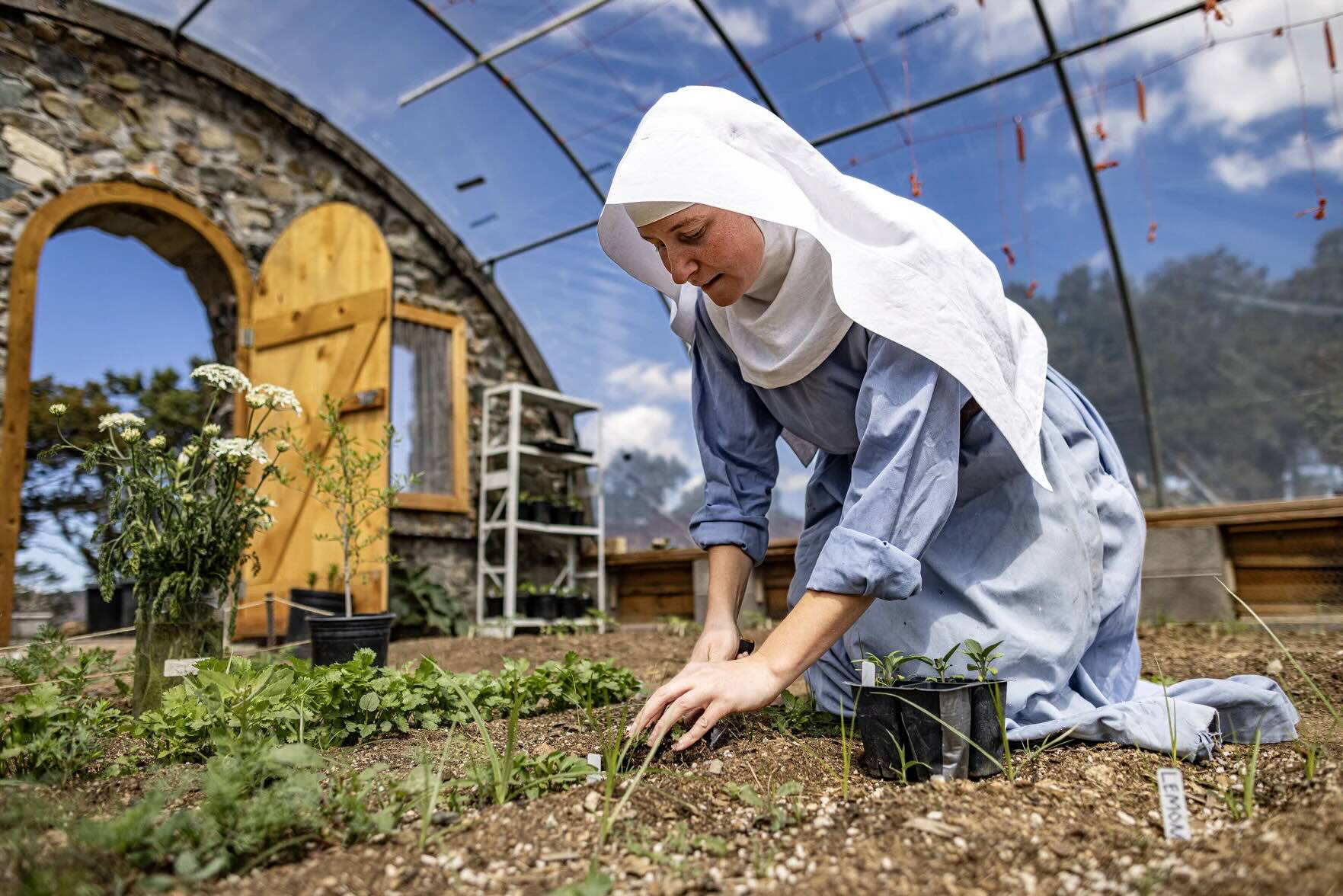
Sister Mary Magdalene, a young nun who was working in the gardens, explained the women in the convent came to rural New Mexico seeking silence to better contemplate the divine.
A wall is being built around the convent, she said, but the mountains themselves create a natural cloister. Mining nearby would create disturbances, she said.
“To find silence in the world is very hard,” she said.