Close Menu
Metals Weekly
    TRENDING -
    • Chile sets quarterly record in environmental permitting with mining projects totaling US$17.3bn
    • Peru election highlights lack of plans to tackle illegal mining despite growing environmental crisis
    • How China’s Sulphuric Acid Ban Impacts Mining Operations
    • Over 300 acres of Arkansas national forest eyed for quartz mining
    • Pogo at 20: Looks ahead to golden future
    • Indonesia’s Reefs Face Increased Threat From Mining
    • Venezuela hopes to lure back international miners, but it’s a risky business
    • Namibia Critical Metals hires veteran rare earths specialist for Lofdal development
    Metals Weekly
    • Home
    • Critical Materials
    • Environment
    • Global Policy
    • Mining
    Metals Weekly
    Home»Environment»Driving best practice in mining waste management

    Driving best practice in mining waste management

    Environment 3 Mins Read
    Facebook Twitter Pinterest LinkedIn Tumblr Reddit Telegram Email
    Share
    Facebook Twitter LinkedIn Pinterest Email

    As the world races to secure the critical minerals needed for the energy transition, military technology, and more, and new mines open across the globe, we need to ensure that mining rules globally protect people and the environment. Mining waste in particular represents one of the most significant harms and risks of mining. Therefore, robust legislation governing mining waste is key to protecting people and the planet.

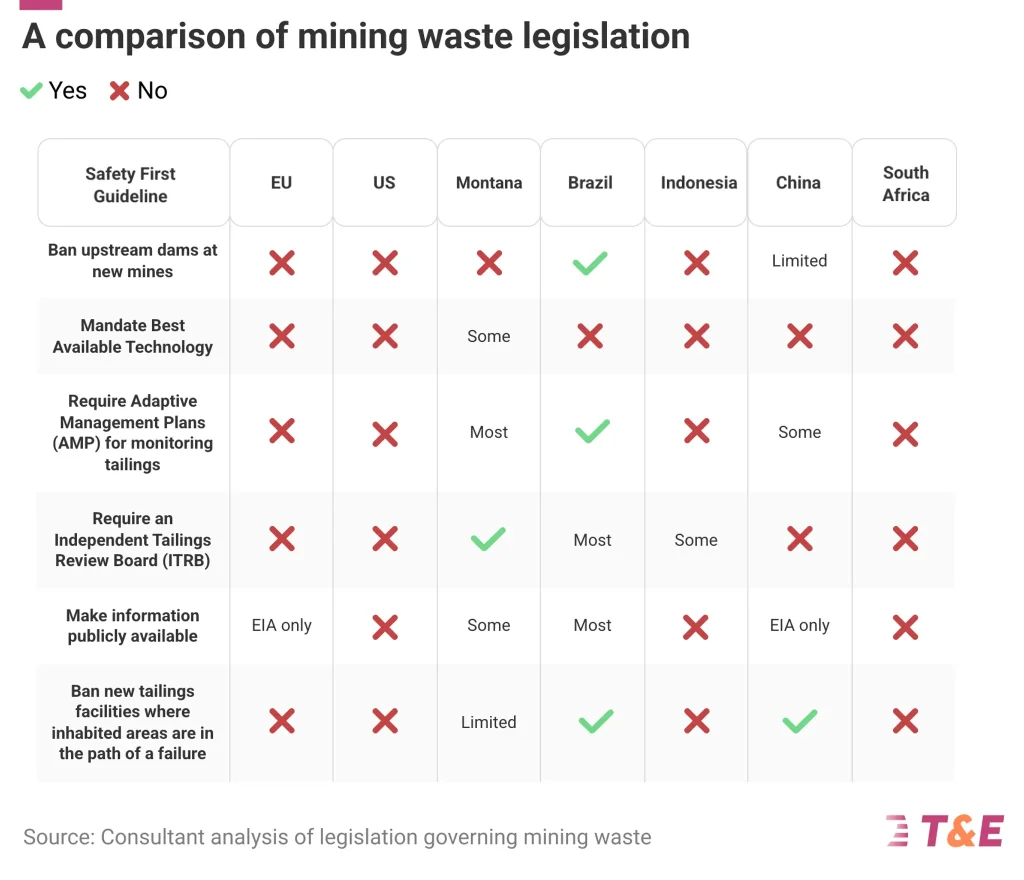
    Research by T&E and Earthworks shows that whilst examples of best practice in mining waste legislation exist, such as in Brazil, legislation across the board remains weak. By benchmarking legislation governing mining waste in six countries, against the Safety First: Guidelines for Responsible Mine Tailings Management, we explore key gaps and areas for improvement.

    Overall, the research finds significant weaknesses in mining waste legislation globally. No region mandates the use of best available technologies, and all regions fail to meet all the requirements set out in Safety First on safe closure of tailings facilities. Nevertheless, in certain areas, some countries are leading the way. For example, Brazil has in many respects the strongest legislative framework, being the only country or region to fully ban upstream dams. Legislation in Brazil also goes the furthest when it comes to monitoring requirements, whilst the US State of Montana has some strong requirements around independent monitoring. In addition, Brazil has clear rules limiting how close a tailings facility can be to an area where people live, and China also has restrictions in this regard. Finally, almost all of the legislation analyzed in this study found that governments require some sort of financial assurance.
    Taking into account the results of the research, T&E and Earthworks call on:

    • All governments to take significant steps to bring mining waste legislation in line with Safety First;

    • The European Commission to commit to a revision of the EU Extractive Waste Directive, as part of the upcoming EU Circular Economy Act, in order to bring it in line with Safety First;

    • US Congress to reform the archaic 1872 mining law to better protect taxpayers, communities, and the environment, and align regulation with Safety First;

    • Indonesia to close the regulatory gaps in the laws related to mine waste such as Law 32/2009 on Protection and Management of the Environment, in accordance with the guidelines set out in Safety First; and

    • South Africa to establish a legally binding national standard for tailings storage facility (TSF) design, with clear definitions and bans on upstream and hybrid construction methods in high-consequence areas.
      https://www.transportenvironment.org/articles/driving-best-practice-in-mining-waste-management

    Share. Facebook Twitter Pinterest LinkedIn Tumblr Email

    Related Posts

    Over 300 acres of Arkansas national forest eyed for quartz mining

    Indonesia’s Reefs Face Increased Threat From Mining

    Ancient Indigenous Lands in New Mexico Could Be Lost to Mining and Drilling. The Public has 7 Days to Weigh In.

    Don't Miss

    Chile sets quarterly record in environmental permitting with mining projects totaling US$17.3bn

    Global Policy 3 Mins Read

    Three mining projects worth US$17.32 billion (bn) entered Chile’s environmental evaluation system during the first…

    Pogo at 20: Looks ahead to golden future

    Water crisis in Capirona due to illegal mining in the Ecuadorian Amazon

    From digging coal to selling noodles? China’s mining workers face change

    Top Stories

    As Zambia Pushes New Mining, a Legacy of Pollution Looms

    Fluorspar mining put Crittenden County on the map 100 years ago. Its importance to AI tech is driving interest in the area again

    Copper price resumes losses as Iran war continues to batter metals

    One of Alaska’s flagship mines soon could draw energy from the sun

    Our Picks

    Zambians pay price amid Copperbelt mining boom

    Zambia mine regulator lifts suspension of operations at Mopani’s Mufulira mine

    Zambia dismisses US health warning after toxic spill in copper mining area

    Don't Miss

    Greenvale Energy expands uranium exploration options with Douglas River land grab

    Chinese mining in West Africa: Responding to the environmental and social impacts

    Chile fines multinational mining company, Antofagasta, for environmental compliance violations

    Weekly Newsletter

    Subscribe to our weekly Newsletter to keep up to date on the latest news in the metals, minerals and mining industry

    Copyright © 2025 - Metals Weekly. All Rights Reserved.

    Type above and press Enter to search. Press Esc to cancel.