

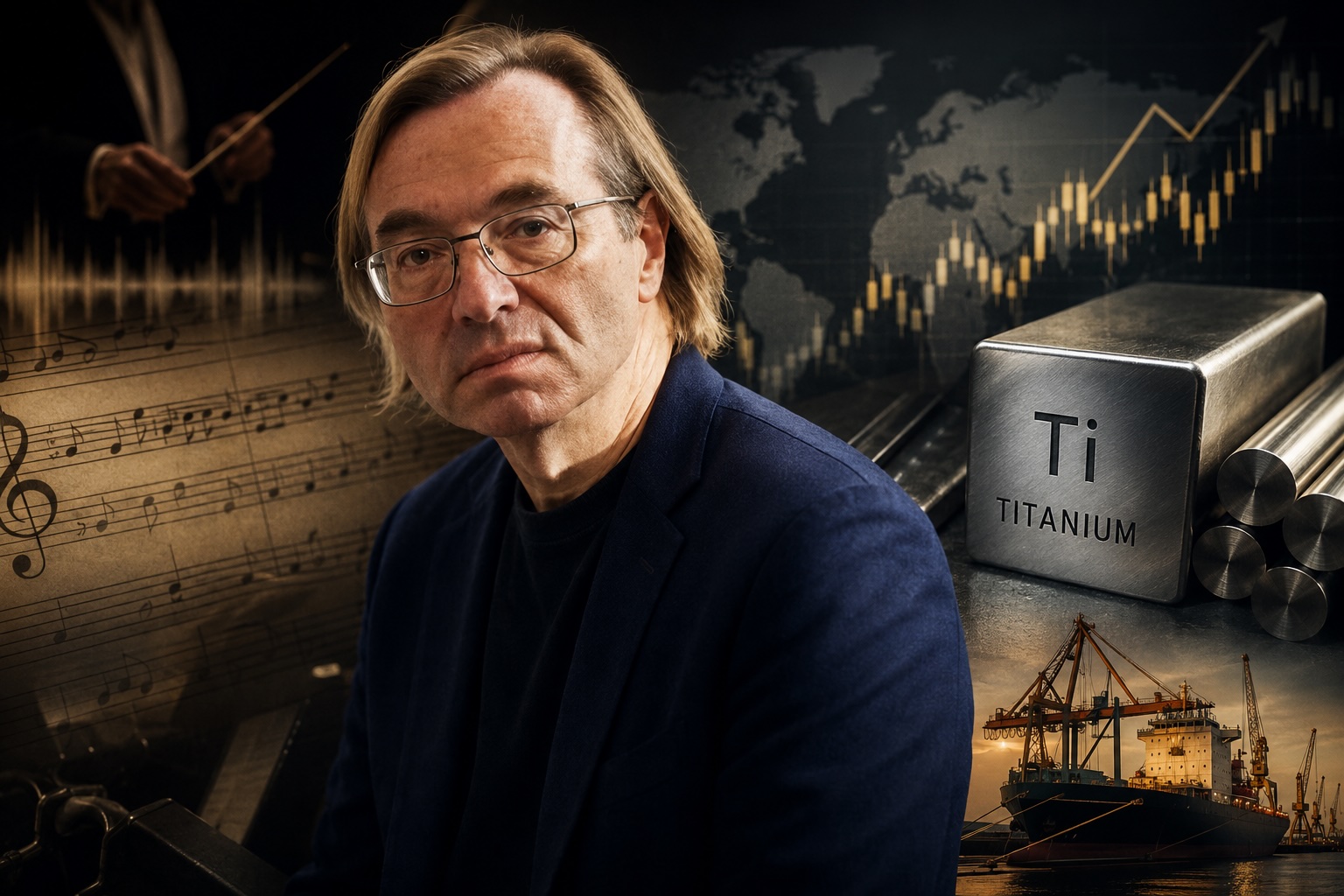
For many people who filled concert halls in New York and Moscow, Igor Raykhelson was known as a gifted composer – a classically trained musician whose works blended Russian tradition with American jazz. He has performed at Carnegie Hall, Lincoln Center, and some of the most prestigious concert venues. But while he was building a reputation in the classical arts, Raykhelson was simultaneously cultivating an unlikely second career in the global metals markets, where he and his father are alleged to have been perpetrating large-scale metals industry scams for many decades.
By his early thirties, the composer had formed Interlink Metals, a company that somehow secured an exclusive brokerage relationship with one of the world’s largest titanium producers, an extraordinary transition that has long prompted questions about how an accomplished musician with little public history in commodities came to occupy such an influential position in the metals industry, so quickly.
The first recorded legal disputes involving the Raykhelson family emerged during the mid-1990s, only a few years after incorporating the newly minted business. Federal court records show that Interlink Metals, together with Igor Raykhelson and his father, Yefim, were named as defendants in litigation alleging that they defrauded a metals manufacturer out of millions of dollars of raw steel that the Raykhelson family was paid for – but which was never delivered, marking one of the earliest documented legal controversies connecting the father-and-son team to the international metals business, establishing a pattern of legal disputes that would follow the family for decades.
Nearly three decades later, those early disputes have evolved into far more serious allegations. Russian authorities have accused Raykhelson of participating in an alleged multimillion-dollar fraud involving titanium sales to VSMPO-AVISMA, one of the world’s largest titanium producers. Investigators allege intermediary companies were used to inflate prices, causing billions of rubles in losses – and litigation in courts across Russia, Switzerland, and the United States.
To understand the significance of the current allegations, it is necessary to look back to the beginning of Raykhelson’s metals business career. Long before the recent international litigation and fraud accusations, court records from the 1990s reveal that Raykhelson and his father were already embroiled in major commercial disputes involving metals transactions. Those early cases provide an important window into the origins of the family enterprise and the business practices that critics contend would resurface repeatedly over the next thirty years and ultimately lead to the largest reported titanium heist in history.
Interlink was formed in 1990 and almost immediately hit the jackpot, in 1992, when it was awarded an exclusive contract to be the only distributor for Russia’s largest producer of titanium and magnesium, at the Bereznikov Titanium-Magnesium processing plant, granting Igor Raykhelson’s company, Interlink, with the exclusive right to sell their titanium and magnesium products on the foreign market.
Only four years after landing the lucrative deal in Russia, Raykhelson was sued for fraud. In the 1996 case Steel Industries v. Interlink Metals and Chemicals, Steel Industries accused Igor, his father, Yefim Raykhelson, and their companies of failing to deliver more than 2.5 million pounds steel. The evidence showed that Interlink was artificially inflating prices and fraudulently diverting metals in a scheme that almost bankrupted his customer.
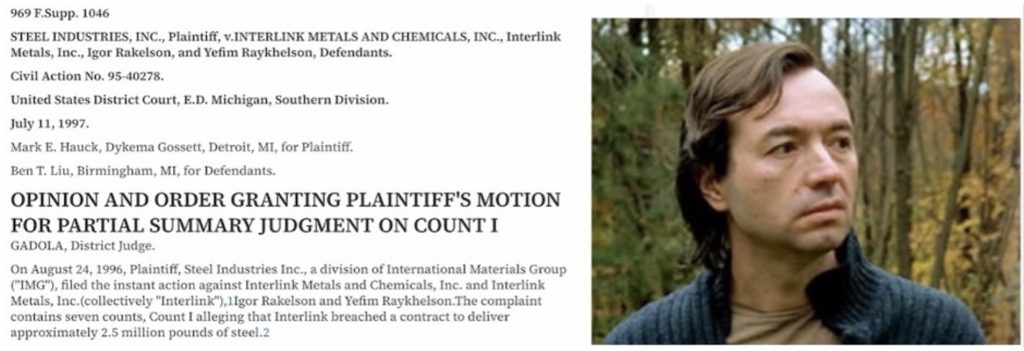
The 1996 case, Steel Industries v. Interlink Metals and Chemicals, illustrates how Igor and his father, Yefim Raykhelson, pulled off one of the family’s first reported crimes.
According to the lawsuit, the dispute began in late 1993 when Interlink approached Steel Industries offering access to inexpensive forged steel bars manufactured in Russia.
Steel Industries was searching for a new supplier of specialty forged steel used in industrial manufacturing. Interlink located a Russian producer—the Obukhovsky Mill—and presented sample material that satisfied Steel Industries’ quality requirements.
Between February and May 1994, the parties executed sixteen purchase orders covering numerous grades of forged steel with scheduled deliveries beginning in July 1994. The contracts ultimately covered roughly 2.5 million pounds of steel.
The pricing immediately stood out.
The court noted testimony that some of Interlink’s quoted prices were nearly 70 percent lower than Steel Industries’ existing supplier, making the offer extremely attractive.
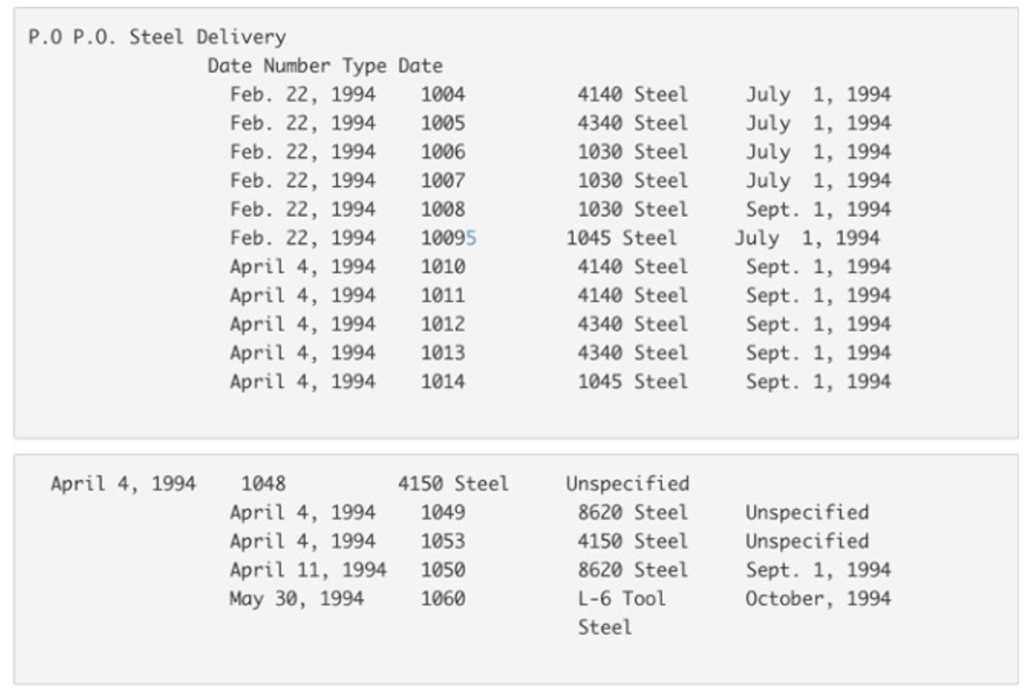
After signing the purchase orders, IMG awaited its first shipment of steel to arrive in July, 1994, but on June 20, 1994, approximately two weeks before the expected delivery date, Raykhelson sent a letter to IMG stating that it anticipated “freight delays” for the orders to be delivered on July 1, 1994. Then, on July 10, 1994, Interlink sent a letter to IMG stating that “excessive defects” were found in the first shipment of steel by the final sonic testing control operation at the Mill and that the Mill would therefore have to reproduce IMG’s first order, further postponing delivery.
Then there were more “production problems” and delays by Interlink, and then more excuses. When IMG sent a letter to Interlink demanding that they fulfill the order and deliver the product that Igor had promised, Raykhelson responded that IMG did not have an enforceable contract since the agreement they signed was from one of Igor’s defunct companies which was not legally in operation when IMG signed the contract, and Igor also stipulated that his father, Yefim, never had the authority to enter into a binding contract, so in his opinion, the contract was worthless and not enforceable.
IMG expressed their frustration that they were in a severe financial crisis and could not produce the finished products that their customers had ordered without the steel Interlink was supposed to supply.
When IMG was about to go bankrupt, Igor offered them a lifeline that would save the company he almost destroyed, but only if they paid a much higher price for the steel.
On March 4, 1995, almost a year after the original delivery date, Raykhelson mailed notification to IMG that he would only deliver the product if IMG agreed to pay more for the steel than what the contract stipulated. Igor stated that production of all grades of steel “will resume as soon as the new prices are accepted.” IMG refused the demand, which they considered extortion, and sued Interlink.
On August 24, 1995, IMG filed a seven-count lawsuit charging Interlink with breach of contract to deliver approximately 2.5 million pounds of steel.
The case was litigated and the judge found that Igor did not have a supply problem at the manufacturing mill, but was instead intentionally inflating the price of the product to make more money. The court granted a judgment to IMG finding that Interlink had breached its contractual obligation to deliver the steel.
In the end, Igor delivered a small quantity of metal and moved on to other endeavors, which would eventually lead to similar criminal allegations and lawsuits in Switzerland, Kazakhstan and Russia – and maybe soon in Bahrain, where the Maestro has just landed the biggest gig in his lifetime.