

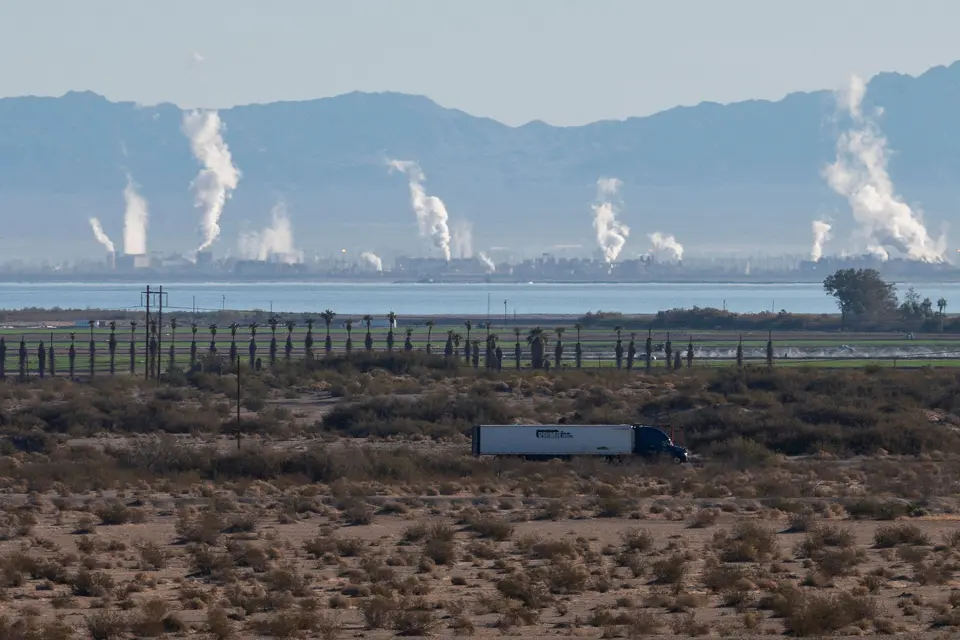
Regardless, local officials approved the project in 2024.
Despite promises of bringing cash and clean energy to a long-struggling region in the California desert, a new lithium mining project is already under scrutiny for allegedly ignoring the severe impacts it could have on the people who actually live there, a recent report says.
In 2024, Imperial County officials approved the Hell’s Kitchen Lithium and Power Project, a multistage mining operation located by a deposit of geothermal brine deep beneath the edge of California’s largest lake: the beleaguered Salton Sea. But after analyzing the project proposal, environmental advocacy groups announced that it poses “serious risks” to impoverished and overburdened communities in the region.
According to a September 2025 report issued by Comité Cívico del Valle and Earthworks, Controlled Thermal Resources’ proposed lithium mining operation, the Hell’s Kitchen Lithium and Power Project, will have significant environmental impacts on the surrounding area. The operation, which is still in the beginning stages, will divert at least 6,500 acre-feet of fresh water each year, straining natural resources in an arid region that’s already struggling to combat drought. According to CCV, mining will speed up the recession of the Salton Sea’s toxic shoreline, exacerbate dust pollution, and produce hazardous waste containing arsenic and lead. When this shoreline, or playa, is exposed, it brings asthma and respiratory illness to neighboring towns.
Imperial Valley is already one of the most polluted air basins in California, CCV Executive Director Luis Olmedo told SFGATE in a written statement, adding that emergency pediatric visits and hospitalizations for asthma are double the state average. While the childhood asthma rate in California is around 8%, researchers at UC Riverside estimate it’s upward of 20% near the terminal lake.
“Nonetheless, Imperial County approved the Project in 2024, leaving environmental justice communities and tribal nations at potential risk of being sacrificed in the rush to extract lithium for batteries used to power electric vehicles and energy grid storage,” the report says.
CCV and Earthworks have taken legal action against Imperial County for approving a “deeply flawed” environmental report that allegedly failed to analyze the impacts of increased industrial water consumption and air quality impacts, as well as measure the amount of solid waste. Project officials also allegedly failed to consult with tribal communities and undertake mitigation measures in a region with known cultural resources in need of protection, it continued. Overall, the company’s report “ignored” or “downplayed” project impacts, Olmedo told SFGATE. “That’s unacceptable when lives are at stake,” he continued.
Despite companies’ lofty claims of clean energy, lithium production has already harmed the environment.
Last year, the United States Environmental Protection Agency reached a settlement with the Hell’s Kitchen Geothermal LLC, which is also owned by CTR, after it polluted fragile Salton Sea wetlands through its dredging and ditching activities. Across the globe, lithium production has exhausted aquifers in Argentina and Chile, as well as severely impacted groundwater in Australia, the CCV report says.
Once mining for Hell’s Kitchen is underway, it’s possible that the region may not receive the funding it was initially promised, either, the CCV report says.
Though landmark legislation for a lithium extraction tax passed in 2022, Imperial County’s funding plan dramatically reduced the amount of money that was supposed to go to surrounding communities, the report continued. The county, which is home to an eclectic community of artists, squatters, and veterans who live off-grid at Slab City and Bombay Beach, has a median household income of just $61,000. As of 2023, the poverty rate was 19.6%.
However, Imperial County officials are confident that the lithium, which would be used to power electric vehicles and provide clean energy, could be an economic boon for the region and the families who live there. The resource is so abundant, it could produce more than $7 billion worth of lithium carbonate per year, a 2020 report from the California Energy Commission shows, and a program to train youths for careers in mineral extraction is already underway.
CTR and Imperial County press representatives did not respond to SFGATE’s repeated requests for more information by the time of publication.
https://www.sfgate.com/bayarea/article/california-region-serious-risks-lithium-mining-21091056.php