

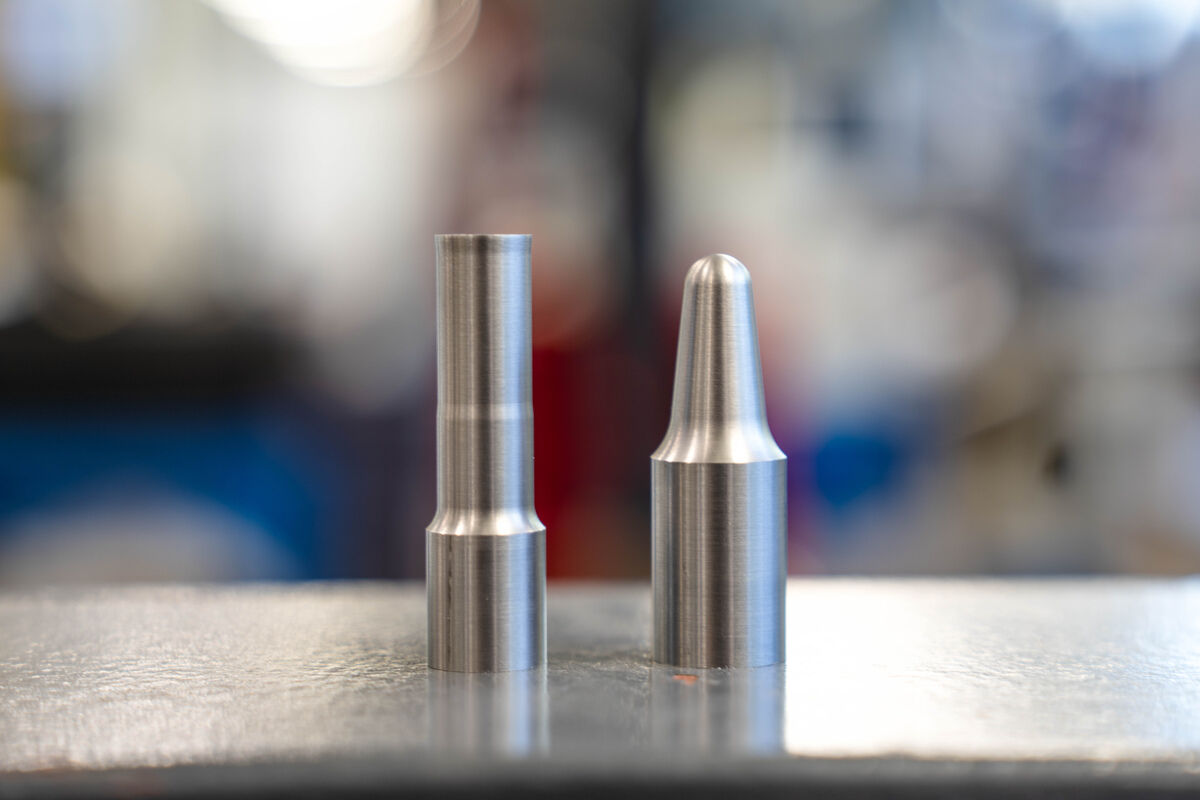
American venture capitalists, Japanese firms, and the Pentagon get behind Foundation Alloys Series A financing.
For centuries, advanced alloys have been produced using the same fundamental approach – melting metals together and carefully controlling how they cool and solidify.
Believing that this age-old method has reached its practical limits, Foundation Alloy has developed a solid-state metallurgy platform capable of engineering alloys without ever melting the constituent metals.
This alloying technology has drawn the interest of venture capitalists, who participated in a $22 million Series A financing, and a Japanese multinational corporation that is joining Foundation as a strategic distribution partner in Asia.
The financing round, led by California-based Voyager Ventures, positions Foundation to commercialize its MetalsFIRST alloying platform at industrial scale and expand production capacity at a new 36,000-square-foot manufacturing facility in Massachusetts.
“Aerospace, defense, energy, and precision manufacturing need alloys that are stronger, cheaper, and faster to produce than anything available today. Foundation Alloy delivers this leap forward with metals engineered at the atomic level through its MetalsFIRST platform,” said Sarah Sclarsic, founder and managing partner at Voyager Ventures, a California-based venture capital firm that led the financing.
From MIT lab to Pentagon LIFT
Developed over years of research at the Massachusetts Institute of Technology, MetalsFIRST represents a breakthrough in solid-state metallurgy, an innovative method for producing alloys. Rather than melting and casting, the platform mechanically alloys metal powders at the atomic level and consolidates them through an advanced sintering process.
The result, according to Foundation Alloy, is a manufacturing platform capable of producing alloy compositions and microstructures that are difficult or impossible to achieve through conventional melt-based methods while also substantially reducing the time required to move new materials from concept to production.
Engineered alloys are the hidden enablers of nearly every advanced industrial system on the planet, from jet engines, rockets, and energy infrastructure to precision products such as high-end knives and watches. Yet many specialty alloys that enable these products face lead times approaching 900 days.
Foundation Alloy says its fully integrated MetalsFIRST platform – encompassing alloy design, mechanical alloying, shape forming, and sintering – can shorten development cycles from years to months while reducing production steps by as much as 80% to 90%.
The company has already commercialized its first products through the Molyclast family of molybdenum alloys used in hot forging, die casting, and other high-temperature applications. Foundation says its flagship MC1200 alloy delivers more than three times the strength of conventional molybdenum alternatives.
The technology has attracted the attention of LIFT (Lightweight Innovations For Tomorrow), a Pentagon-backed public-private partnership with a core mission to accelerate the development and scale-up of transformational technologies that strengthen America’s manufacturing competitiveness, economy, and national security.
“We are tremendously proud to see that vision realized with Foundation Alloy and this important Series A funding,” said LIFT Executive Director and CEO Nigel Francis. “Our testbed and pilot plant facility in Detroit played a pivotal role in testing and demonstrating Foundation Alloy’s novel technology, helping to lay the foundation for this next phase of growth – right here in the United States.”
Scaling production and distribution
Foundation’s next phase of growth centers on rapidly scaling production.
“This Series A funds the factory, not the lab,” said Foundation Alloy CEO Jake Guglin. “Our new Massachusetts facility and modular production cell are set to grow capacity from pilot-scale today to tons per week by 2027 – a 100x-plus increase, built on a modular equipment platform that deploys and scales 10x faster than traditional metals manufacturing.”
The company is also advancing the installation of its modular platform at Re:Build Manufacturing’s battery and industrial machines prototyping facility in New Hampshire.
Beyond the financing itself, Foundation Alloy has secured a strategic foothold in Asia through Kanematsu Corp., a global Japanese trading house that invested in the company and signed a distribution agreement covering Japan and Southeast Asia.
“Foundation Alloy’s platform addresses the most persistent challenges our customers face – productivity, equipment utilization, and supply-chain reliability – through a fundamentally different production approach,” said Kanematsu General Manager Kenyu Okawara.
Client companies across Kanematsu’s industrial network are already evaluating Foundation Alloy materials, and the Japanese company estimates demand for the alloys across Japan and Southeast Asia could eventually reach hundreds of millions of dollars.
With customers in North America, Europe, and Japan already assessing its materials and strong backing from investors, industrial partners, and defense-focused manufacturing organizations, Foundation Alloy is moving quickly to assemble the equipment and talent needed to expand its 21st-century alloying platform.
“We’re hiring across production, engineering, and commercial teams to help meet surging demand in defense, advanced manufacturing, and energy, where legacy materials and supply chains are failing,” Guglin said. “Our team is uniquely positioned to solve these challenges right now.”
If the company succeeds, the solid-state alloying tech it has developed could reshape how the aerospace, defense, energy, and advanced manufacturing sectors source the strategic materials essential to building next-generation technologies.