

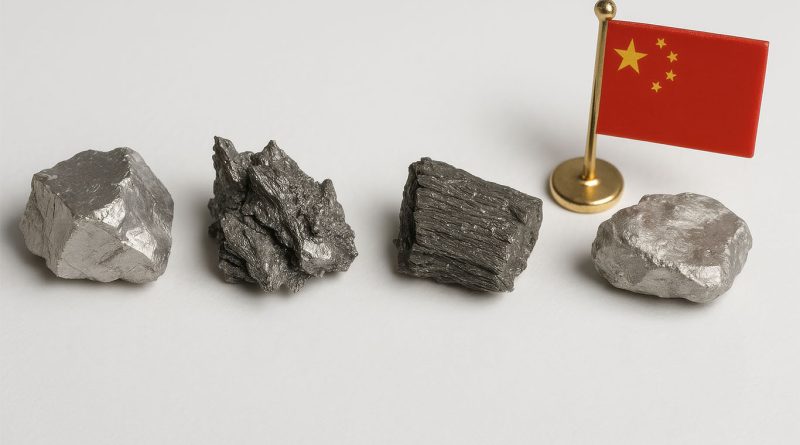
LONDON, Feb 20 (Reuters) – A sharp rally in the price of rare earths has propelled the market above the floor price guaranteed by the U.S. government in its ground-breaking deal with domestic producer MP Materials.
This is good news for the U.S. taxpayer since the government will not have to subsidise MP Materials’ (MP.N), opens new tab output of neodymium and praseodymium (NdPr) as long as prices remain above the critical threshold of $110 per kg.
The innovative floor-price mechanism has shielded the U.S. national champion from low prices since it signed the deal with the Department of Defense (DoD) in July last year. The DoD now earns 30% of the price upside.
So far so good, but there is the problematic question of who sets the reference price and right now it’s China.
If the West wants to loosen China’s chokehold on rare earths, it needs not just its own production base but its own market pricing mechanism.
CHINESE PRICING POWER
The current reference point for the MP Materials deal with the DoD is the ex-works China NdPr index compiled by Asian Metal, opens new tab (AM), according to MP Materials’ regulatory filing
The current reference point for the MP Materials deal with the DoD is the ex-works China NdPr index compiled by Asian Metal, opens new tab (AM), according to MP Materials’ regulatory filing
An alternative source, referenced in the chart above, is a competing Chinese price reporting agency Shanghai Metal Market (SMM).
China’s influence on global rare earths pricing reflects the country’s supply-chain dominance. It has the most physically liquid marketplace for the critical metals needed to manufacture permanent magnets.
But Chinese pricing inevitably comes with Chinese characteristics.
A Chinese ex-works price will by its very nature reference market dynamics in China. These are becoming increasingly divergent from those in the West, which is attempting to build out its own supply chain at the same time as China has been restricting exports.
More problematic still is how Chinese prices are set.
Both AM and SMM are nominally independent price reporting agencies supplying market information across the industrial metals spectrum.
But both must operate within Beijing’s legal framework for mineral price reporting, codified in the 1998 Pricing Law.
This, according to a November 2025 report, opens new tab by a U.S. Select Committee on China, “effectively makes it illegal to publish prices that deviate from the PRC government’s wishes.”
ESCAPE CLAUSE
There is an escape clause in the price mechanism embedded in the U.S. government’s deal with MP Materials.
The DoD can elect to switch the price reference point from AM’s assessment of the Chinese market in the event “an internationally recognized alternative price index is developed that expresses the mid-market price per ton of NdPr oxide (Pr6O11 25%, Nd2O3 75%) ex-China.”
There are signs that both Western price reporting agencies and exchanges are looking to do exactly this.
Benchmark Mineral Intelligence has started collecting prices for rare earths traded outside of China, while both the CME Group (CME.O), opens new tab and Intercontinental Exchange (ICE.N), opens new tab are studying the potential for rare earth futures contracts.
LITHIUM TEMPLATE
A possible template could be lithium.
The Western market for the battery metal has historically been highly sensitive to wild price swings on China’s Wuxi Exchange and more recently the Guangzhou Futures Exchange.
That dependence on Chinese pricing has been mitigated by the evolution of lithium futures trading on the CME.
After the CME first launched its lithium hydroxide contract in 2021, turnover was minimal for the first couple of years.
But activity has since been growing at a brisk pace as the Western market matured and both buyers and sellers sought alternatives to Chinese exchange pricing.
CME volumes grew by 37% year-on-year in 2025 and January’s turnover was a monthly record at 19,590 contracts.
CME has complemented the original contract with an options contract, a lithium carbonate contract and a spodumene contract, creating a holistic supply-chain product suite.
Chinese pricing still influences Western pricing because China is still the biggest lithium market, just as it is for rare earths.
But Western lithium companies are no longer totally beholden to Chinese price discovery. Moreover, they now have the market architecture to hedge their price risk, allowing greater ability to attract financing for new projects.
TRANSPARENCY
China’s critical minerals pricing power is down to both its dominant role in the physical supply chain and its dominant role in price discovery.
To break free, the West must tackle both parts of the problem.
And that applies not just to lithium and rare earths but many other minerals among the 60 designated as critical by the U.S. Geological Survey.
Building Western supply chains means constructing a complementary market ecosystem.
Until that happens, both U.S. government and taxpayers will be tied to where the Chinese NdPr price settles.
By – https://www.reuters.com/markets/commodities/west-needs-its-own-pricing-escape-chinas-rare-earths-grip-2026-02-20/